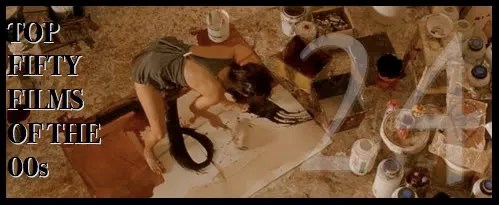
#24 — Vicky Cristina Barcelona (Woody Allen, 2008)
It’s now been over thirty years since Woody Allen cast his cynicism in unyielding bronze by having Alvy Singer assess the state of his relationship with Annie Hall through the use of a dead shark metaphor. Allen is occasionally hopeful in his work, but more commonly he’s the guy who sees much of the world as an exercise in futility, an outcome that is painfully at odds with the aspirations of human nature. The heart wants what the heart wants, but there’s a slim likelihood that it’ll get it. What’s more, if it does, the longed for object of affection will probably prove to be unfulfilling at best, dreadful at worst, a situation arguably made even worse by the unfortunate compulsion to do just about anything to acquire whatever the heart is set upon. Allen has been prolific enough across his career that this may not actually be the predominant philosophy running through his filmography, but it is the primary intellectual flavor of many of his finest works, from Manhattan to Crimes and Misdemeanors to Husbands and Wives. And it is powerfully present in Vicky Cristina Barcelona.
The film begins with two young American friends arriving in Spain for a vacation together. One, played with subtly adjusting sensibility by Rebecca Hall, is pragmatic, refined and restrained, buttoned-up, even a bit stuffy. She is basking in the beauty of the foreign land she visits, but also studying it. In a telling detail, she is not just there as a tourist, but as a committed student, studying the local art and architecture. She is so detached from the alluring beauty of the world around her that she can only approach it academically. The other traveler, played by Scarlett Johansson, is wilder, more devilish, far more open. In particular, she approaches romantic possibilities from a completely different starting point, one more inclined toward the possibilities of polyamory. She’s not promiscuous, simply open. These differing viewpoints are thrown into stark relief when the pair are approached by a handsome artist played by Javier Bardem who propositions them, suggesting a weekend of casual bed-hopping, basking equally in the sensuality of the gorgeous countryside and one another.
This is Allen’s entryway to exploring the myriad of ways that people intimately connect with one another. They can be happily reckless, joyfully wallowing in stimulating physicality. They can take solace in the comfort of pure stability in reasoned partnerships. They can look for that person who offers the dependability of a sharply-cast shadow or find someone who challenges, pushes, infuriates and enlivens them, pulling out the strongest of emotions in the most unpredictable ways. They can plan and plot, or they can take whatever comes, reveling in the uncertainty of a life lived without a map. Through these two characters, and those around them, Allen explores all these possibilities and more. To the degree that he draws any sort of conclusion about these different couplings (and, occasionally, triplings) it is simple as can be: nothing works. Allen’s argument is that, for all the pontificating and emotional reveries, every method of approaching relationships is equally futile. No matter what level of certainty accompanies a person’s conviction, the cold hard realities of how we work will intervene, and the standard issue imperfections of people trying to merge their egos and hearts into one functioning unit will come forward to present their decisive counter-argument.
Despite this grim diagnosis, the film is not dour or somber. Instead it is fluid, witty, light on its feet. It is as slyly charming as the happily hedonistic Spaniard embodied by Bardem. And it is one of Bardem’s most consistent costars in his homeland who gives the film its most significant jolt. When Penelope Cruz arrives at the midpoint, playing the spirited, unbalanced ex-wife of Bardem’s character, the movie shifts under the force of her pointed stare. She tears into scenes with a blinding self-assurance, doling out frank accusations and honey-layered compliments, all reflecting a instinctual embrace of herself, a command of her own life and the place she allows others to have in it. Allen has written a multitude of strong, decisive female characters over the years, and Cruz’s Maria Elena joins that roll call. Cruz, who’s grown by leaps and bounds as an actress in recent years, is penetrating in the role, matching character’s fire with her own.
Allen has been doing his job long enough and well enough that it shouldn’t be surprising that he can still turn out masterful films. At his best, he creates deeply realized, fascinating characters and put them in situations that demonstrate that he, as a filmmaker, still has something to say. And he routinely draws out the best from his actors, proving that strong directing doesn’t always mean flashy directing. Indeed, it often means quite the opposite: getting out of the way and letting your actors tell the story. Vicky Cristina Barcelona has all of these qualities, and finally comes back to that famed metaphor from the the 1977 movie that won Allen the best director Oscar and represented a quantum leap forward for him a s a filmmaker. Vicky Cristina Barcelona tells us that not only in the shark dead, but that, no matter what is done, that shark is doomed from the start.
(Posted simultaneously to “Jelly-Town!”)
Discover more from Coffee for Two
Subscribe to get the latest posts sent to your email.
 Coffee for Two