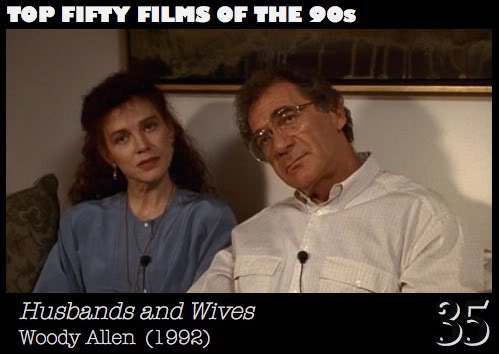
#35 — Husbands and Wives (Woody Allen, 1992)
Woody Allen insists that his films aren’t autobiographical. Even though he’s arguably he has clearer sole authorship of his films than any other American director of the past thirty years, and those films often seem painfully personal, Allen maintains that they are complete works of fiction. The film most likely to inspire him to reassert this point is also the film that makes his argument seem highly implausible. Husbands and Wives was released around the time that Allen went through a very messy, very public break-up with his longtime onscreen and offscreen partner, Mia Farrow, infamously leaving her to enter into a relationship with one of her adopted daughters, Soon-Yi Previn. Previn was in her early twenties at the time, thirty-five years younger than Allen. In the film, Allen and Farrow play a longtime married couple whose relationship suddenly disintegrates, in part because he becomes enamored with a college student. Allen is of course correct when he notes that the film is made up, that it is not a documentary about the tumult in his personal life, just as he’s accurate when he notes that Annie Hall‘s Alvy Singer may have grown up in a house located underneath a roller coaster, but, other resemblances aside, Allen himself did not. But it’s hard to conceive of Allen’s concurrent emotional existence exerting no influence whatsoever on Husbands and Wives. I’m not arguing that Allen is disingenuous in his protestations, but he may be a little confused about the distinction between autobiography and autobiographical.
The strongest evidence that the film was generated from something beyond a screenwriter’s imagination is the very same facet that makes the film extraordinary. It has a raw, unyielding authenticity, a probing consideration of the treacherous fault lines that exist in any relationship. Besides the couple played by Allen and Farrow, there is another played by Sydney Pollack and Judy Davis. As the film begins, they are announcing their plans to separate, treating it with a mature, contained satisfaction. There is no anguish, just intellectual contentedness that the remainder of the film proves is the height of deluded foolishness. At the time of the film’s release, Allen explained his widely detested personal choice with the simple, helpless phrase “The heart wants what the heart wants.” He dramatizes that with force in Husbands and Wives, sending the character’s through seismic shifts that are constantly compromising their emotional footing. It is all acted with devastating skill by everyone in cast, most memorably Judy Davis, who operates with levels of authoritative self-worth and inherent cunning that serve to make the moments of compromise and heartache even more wrenching.
For many, Husbands and Wivesrepresents a clear delineation point. It was no longer possible to separate the art from the artist. Annie Hall may have an enduring influence, but Allen never exactly had mass appeal. Any chance of that happening dissolved completely with his unexpected excursion into tabloid fodder around this point, and the art itself was a chiming reminder of the sordidness he’d now attached to his name. It wasn’t necessarily that great a sacrifice for some to disregard Allen. For others, for me, Husbands and Wives is evidence that the material that starts the celebrity press salivating salivating is incidental. What’s on screen in what counts.
Discover more from Coffee for Two
Subscribe to get the latest posts sent to your email.
 Coffee for Two