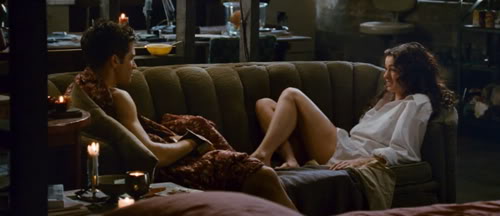
What do you you say about a twenty-six-year-old girl with a terminal illness? That she’s beautiful and brilliant? That she loves Liz Phair and Polaroids, video cameras and Jake Gyllenhaal?
In Love and Other Drugs, Anne Hathaway plays Maggie Murdock, a young woman who’s contracted Parkinson’s Disease at an unusually early age. It’s the sort of alluring ailment performance that has a long lineage. It gives her a chance to flash strength and vulnerability in equal measure, while also guaranteeing there will be a scene or two in which the problem comes to the forefront, giving her some especially showy moments. Hathaway does well enough with it all, but the character feels cobbled together, a smattering of ideas that don’t cohere into a human being.
That’s representative of the whole film. Adapted from a book about working as a pharmaceutical salesman, the script, credited to Charles Randolph, director Edward Zwick and Zwick’s old thirtysomething collaborator Marshall Herskovitz, often feels like it’s trying to roll three or four different movies into one. The original book has clearly provided the spine of a story about a directionless young man who finds success hawking medication to doctors, especially when he’s given the chance to push the hot new blue pill called Viagra. He’s played by Gyllenhaal, whose at his best when he’s reveling in the art of the sell, charming receptionists and scheming against physicians. The more Gyllenhaal is asked to do, the less impressive the performance. And by the end, he’s asked to do a lot. There are stretches when the film seems to change it focus a couple of times per reel, shifting from a ribald, snappy romance to a near-satire of an overdosed culture to a thudding drama about the way impossible dilemmas provoke obsessive quests for solutions. This isn’t automatically a problem. Some great films are specifically great because they take on so much, becoming impressive to a dizzying degree with the sheer grandness of their ambition. That sort of film is reliant of an especially adept director to corral it all together and make the intrinsic tone shifts feel natural. Edward Zwick isn’t that sort of director.
Zwick has made an awful lot of earnest, flavorless, self-consciously important movies since thirtysomething‘s success got him a permanent key to the Hollywood gates. His films almost always come out in the late fall, and, on paper anyway, look like the mighty Oscar contenders, the weightiness of their subjects practically sending out a homing signal that can be heard only by gold-plated trophies. They’re also usually bland, arid and monotonous. Even the better ones have pulses that barely register. Love and Other Drugs is closer to his first feature, About Last Night…, an adaptation of David Mamet’s play Sexual Perversity in Chicago, which is about as good as a film that hinges on the insightful acting of Rob Lowe and Demi Moore ever could be. But where that had focus and simplicity, Other Drugs wanders like a movie that needs a dose of Ritalin.
Discover more from Coffee for Two
Subscribe to get the latest posts sent to your email.
 Coffee for Two
“which is about as good as a film that hinges on the insightful acting of Rob Lowe and Demi Moore ever could be” …You turn a phrase better than most people turn a corner
You turned one pretty well yourself there, fella.