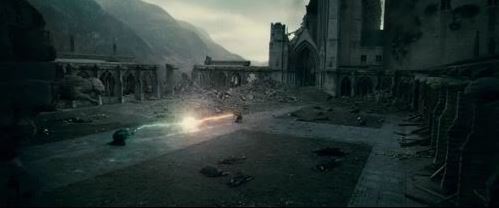
“Words are our most inexhaustible source of magic,” muses Albus Dumbledore in the concluding film in the Harry Potter cinematic saga that has romped across the media landscape for a decade. Sent to his heavenly reward in a prior film, but, in true Jedi fashion, still available to dispense advice, the former headmaster of Hogwarts appears to the stalwart boy wizard and gives him the information he needs to bring his long-brewing epic confrontation with the greatest magical evil ever to roam the world, Lord Voldemort. It is that offhand musing on the boundless wonder of language that is most useful, though, in that it serves as a gentle reminder of the primacy of the novels that started it all: J.K. Rowling’s seven tomes of ever increasing girth. There were a uncommon sensation for a reason, after all. And if there’s anything the eight films they spawned argues consistently and convincingly, it’s that imagery, special effects, acting and all the other components required to make a movie ultimately cast lesser spells.
At least that drab conclusion can be drawn from Harry Potter and the Deathly Hallows, Part 2 and the decisive majority of its forbears. Having signed his name to the last four outings, director David Yates is as clear an author of the film series as anyone else, save perhaps screenwriter Steve Kloves, who has been responsible for every adaptation except for one. The faint praise I can offer to Yates’s efforts on this closing chapter is that he’s fashioned what is probably the second best of the Harry Potter films. Of course, he has the benefit of finally being able to deliver a real ending instead of rolling the closing credits over ragged, dangling threads. But he also orchestrates the grand finale spectacle of the film with reasonable deftness. He provides a surging sense of awestruck import as the brimming band of characters fights the wizardly war that’s been promised almost since the very moment that Harry was informed of the great specialness within him that no one else recognized but he knew deep down must be so.
While the final book was released exactly four years ago tomorrow, Yates and his collaborators seem to realize that when the final notes of the score play at the end of their coattail journey, it will represent an even more definitive close to the saga. The films have always been meager echoes of the book–and have rarely aspired to be anything more–but they have been one more thing for the fans to hold onto, a rejuvenated entrance to the world they adore. For Warner Bros. executives, the end of the film series means the loss of a major support beam in their fiscal house, but it’s a sadder loss for those who clutch the hardbacks to their hearts. Barring a significant change of heart from Rowling, there’s no new dispatches pending from their favorite fictional land. Yates does what he can to make the film into a fitting victory lap, then. Major characters get exalted turns across the screen and many members of the troupe of great British thespians who have taken their turn on the Hogwarts faculty list get at least a cameo moment. Emma Thompson may not even have a full second of screen time as Sybil Trelawney, but there she is, frizzed out and daffy-looking.
By now, the filmmakers have totally given up on any pretense of finding the way for the film to stand alone, or even make efforts to reacquaint the non-faithful with the particulars of the world. Everything just is, and, anyway, the books and DVDs are readily available for anyone in need of a refresher course. In a way, the version of ambiguity this blankets over the film is somewhat nice, at least to the degree that it winds up scrapping the more common blockbuster movie approach of ponderously spelling out the sort of plot points that audiences were once expected to intuit. There’s a certain amount of dot-connecting expected of total newcomers (an unimaginable group) and the forgetful (that would be me). It’s a quality that would actually be quite admirable if it weren’t so clearly the product of creative laziness rather than artistic intent.
I’d love it if these films were better. I think they deserve to be. Rowling clearly created an epic tale that had all the right elements to become grand, transporting movie entertainments. Instead, Deathy Hallows, Part 2 feels more like a wan recreation than something that could stand the test of time without the original book propping it up like a support strut. There are nice moments here and there–a snake attack viewed from the other side of a smeared window is an especially simple and strong piece of visual staging–but most of the film operates with a sort of dedicated blandness. The audience is both guaranteed and, presumably, committed to accuracy over fresh creativity. It’s a combination that obviously discourages adventure, which, by my reckoning, is the quality that the Harry Potter films cry out for most.
Discover more from Coffee for Two
Subscribe to get the latest posts sent to your email.
 Coffee for Two
Dear friend,
You’ve got some stiff competition: http://www.flickr.com/groups/monkeysreadinganewspaper/
Love,
Rachel
Many of those monkeys aren’t reading anything. That site is a RIP-OFF!