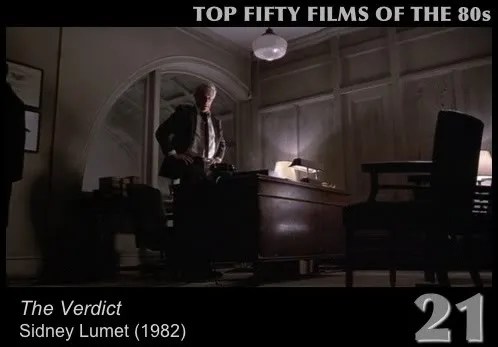
#21 — The Verdict (Sidney Lumet, 1982)
Sidney Lumet directed his first feature film in 1957 and his last one in 2007. Both those efforts were sensationally good, and Lumet had enough similarly marvelous efforts during the half-century between the two that it seems counter-intuitive to proclaim that he belongs to one decade more than any other. And yet, I can’t help but associate Lumet most strongly with the filmmaking of the nineteen-seventies. This isn’t just because he made a couple outright masterpieces right in the middle of that especially fertile span of American cinema; it’s because his smart, compact, unobtrusive style was especially well-suited for an era when grit and authenticity were the prevailing principles of the finest, most celebrated auteurs. Lumet’s defining characteristics–consummate professionalism and an instinctual aversion to phoniness–were suddenly in vogue and his films, even those that faltered, were like blueprints for how to approach the craft. His work felt right, as solid as necessary as a foundation brick. Since it’s an exemplar of all those qualities, The Verdict has long struck me as one of the last, dwindling echoes of nineteen-seventies cinema.
The film stars Paul Newman as Frank Galvin, an alcoholic attorney whose practice has fallen on bad times. He takes on a tricky medical malpractice case with the idea that it could be significant enough to pull him out of his professional funk, but it soon becomes clear that it’s his conscious as much as his career that he’s rebuilding. Indeed, it’s his inner being that’s more desperately in need of repair. Based on a novel by Barry Reed, the film boasts a screenplay by David Mamet that’s a model of focused, shrewd, uncompromising storytelling. There’s never a sense of showing off, of layering in dialogue designed to call attention to itself and, by extension, the cleverness of the writer. Instead, there’s a fervent devotion to being true to the moment, finding the right emotional tone for each individual moment, showing how easily things can fall apart and good intentions can be turned back upon the person who has them. The plot is complicated and yet always wonderfully clear. Just as importantly, the emotional impact of each turn of the plot is vividly realized. Through all the machinations of the film, the creators never lose sight of the characters, the people, that the plot wreaks its havoc upon, knowing full well that it’s the levels of empathy that gives the work a deeper impact.
I mean it as no small compliment when I say this may very well be Newman’s finest performance on film. The astonishingly skilled actor had an unrivaled knack for melding the iconic with the intricate that showed in a variety of performances, but his work in The Verdict is like a depth charge of fiercely dueling instincts. Moving into his late-fifties at the time, Newman seemed to couple a lifetime of experience with the swelling sense of limited time. In some respects, possibility was beginning to dwindle for him as an actor, no matter how big of a star he was, in much the same way that his character had to see this case as his last chance for personal redemption. Newman brings vulnerability to the role, but it’s more the sense of resulting unease that defines the performance. There’s a wounding desperation to much of Frank’s progress in the story and Newman realizes it with grueling accuracy.
The most potent, poignant moment in Newman’s performance is also the sequence that demonstrates the sort of daring through simplicity that was one of Lumet’s hallmarks. When Frank loses his star witness right before the trial, he works the phones with an anguished neediness that he’s trying to mask with confidence and control. Lumet presents the scene largely as a single sustained shot, and one with the camera fairly distant from the character at his desk. It strips away the levels of orchestration that are usually built into scenes–tension heightened by a swirling camera or an image built on pressing in on the character’s trembling hands or face–and let’s the true drama of moment carry the scene. By flying in the face of cinematic convention and trusting completely in his lead actor, Lumet winds up heightening the tension of the scene in a way that an avalanche of technique never could. As with the rest of the film, it’s the plainspoken nature of the scene that gives it the necessary gravity. Lumet wasn’t straining to reinvent cinema. He didn’t need to; he had mastered it.
Discover more from Coffee for Two
Subscribe to get the latest posts sent to your email.

