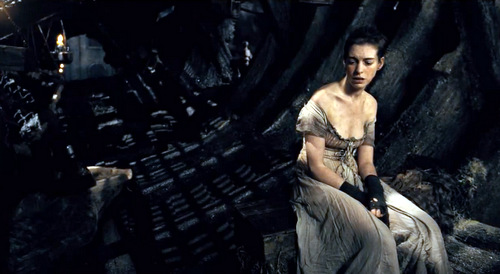
Let’s start with this: if Jennifer Hudson could win a Best Actress in a Supporting Role Academy Award, despite showing no apparent capacity for acting beyond a suitable performance of a show-stopping musical number, then it’s somewhat remarkable that Anne Hathaway roaring with anguish through “I Dreamed a Dream” didn’t culminate with the personal delivery of an Oscar to her on the set of Les Misérables as the various crew members surrounded her, applauding. In bringing the blockbuster musical adaptation of Victor Hugo’s classic novel to the screen, director Tom Hooper disregarded convention and had the actors sing live on set instead of lip-synching to prerecorded vocal tracks. The reasoning is clear enough; it’s the same thought process that would discourage any director from wanting actors to mouth dialogue being played back from a tape. Since the vast majority of Les Misérables is presented strictly through song, with barely a word that isn’t sung, he wanted his performers to feel the emotions they were conveying. He wanted them to act and sing at the same time, hardly a revolutionary notion. It serves Hathaway best. She’s a raw nerve for the duration of her role, culminating in the combustion of “I Dreamed a Dream.” Despite my fanciful notion, that Oscar didn’t arrive on the set, but it sure as hell is going to be put in her trembling hands come late February.
Hathaway’s performance is the one unqualified success in Les Misérables. Other than that, it’s as scattershot as a nineteenth century firefight. By now, the storyline should be familiar to most: the noble sufferer Jean Valjean, the obsessive police inspector Javert, the doomed Fantine, the rescued Cosette, the French revolutionaries taking to the streets of Paris. The original novel approaches 2000 pages in its original French, and, even running at nearly three hours, the musical necessarily condenses and contracts. The effort shows, with much of the drama feeling rushed and confused. More problematically, the psychological underpinnings are mere shadows. That puts additional pressure on the performers to make the characters work, which in turn makes Hooper’s less successful casting choices all the more damaging, especially Russell Crowe as Javert. Hooper’s approach to filming may have been intended to show how effectively every member of the ensemble can both act and sing, but, on the evidence here, Crowe can do neither. It’s as dire a piece of uncorrected miscasting as I can recall in any recent film of this size and stature.
Between the triumph of Hathaway and the train wreck of Crowe, performers sit on all points of the Spectrum. Hugh Jackman undoubtedly dreams of this sort of film role every time he retracts his special effect Wolverine claws–he has a chance to flash his musical theater chops in the most masculine manner possible–and he does very well, even if he sometimes succumbs to overplaying the heavy drama built into the role. Amanda Seyfried has a lovely singing voice, but can’t make Cosette anything more than a bland object of romantic desire (it’s especially unconvincing that she would inspire such longing when her ostensible romantic rival, Éponine, is played by gorgeous and charismatic newcomer Samantha Barks). As for Helena Bonham Carter and Sacha Baron Cohen as villainous comic relief the Thénardiers, the clearest way I can communicate my reaction is to note that their scenes seemed to stretch on for a painful eternity. And I realize that expecting anything approaching verisimilitude in regards to the story’s French locale is the height of foolishness, but did the youthful street urchin have to squawk in a Cockneyish accent, as if he’d been shipped over from a Charles Dickens novel in some sort of legendary literature exchange program?
I can’t deny the impressive scope of Les Misérables. The whole thing groans with ambition, and if that sometimes reads as empty bombast, at least there’s a sense of spectacle to it. There’s an earnestness to the project, a fully evident desire to get this thing right for the multitudes who cherish the original musical (or maybe even the novel that provides the story) and will hold onto this for ages as the biggest, boldest record of the piece in question. Maybe that means Hooper and his collaborators occasionally overreach (and Hooper remains that most uncommon of filmmakers: one whose style alternates wildly between utterly pedestrian and garish over-direction), but it’s in the name of clawing their way towards a cinematic work that can live up to the highest of hopes. They don’t reach it. I’d argue they don’t even come all that close to the goal. Still, I admire the sweat that practically flecks the camera lens.
Discover more from Coffee for Two
Subscribe to get the latest posts sent to your email.
 Coffee for Two
I don’t comment often on your movie reviews, but I do like to add a few of my own observations and context when you do review adaptation of an opera or a musical. You didn’t ask, but here it is 🙂
In Seyfried’s defense, I don’t believe Cosette has ever been anything more than a bland object of romantic desire in any version of Les Mis I’ve ever seen or read – including Hugo’s novel. I imagine she must have known this going in, but said “meh…at least I’ll get to go to some rockin’ Oscar parties with the rest of the cast” and I wouldn’t blame her in the least. I like to think of Cosette as cousin to Johanna in Sweeney Todd who also inspires love at first sight in a besotted and misguided young man despite being largely uninteresting. The material just isn’t there to work with.
Speaking of Marius, I’ve never cared for the character who disregards the far more interesting Eponine for the well-turned heel of Cosette and joins the lost cause….BUT Eddie Redmayne made me feel something for Marius for the very first time. I actually cried during Empty Tables, which I usually fast forward right through.
As for the cockney accent, well, now we have a historical holdover problem inherited from decades of Les Mis productions. I’m definitely not sticking up for that decision that has led me for years of listening to the soundtrack saying “what???” to the almost unintelligibly thick accents. Yet I’ll point out that a thick French accent would sound horrible in Gavroches lines: “Zo you’d bettehr run for cover when the puep grows uep!” Mainly what I can say is that Gavroche and all the lower-class denizens of Paris speak with English accents for the same reason the cast of the Death Star does. I’m not entirely sure I can articulate what that reason is, but I think it’s the same reason.
Anyway, those are a few thoughts. In a separate personal email, I’ll send you the suggestions we came up with for a Muppet version of Les Mis.
First of all, know that the “You didn’t ask” part is somewhat mistaken. There’s a tacit invitation at all times, and you can consider this a verification that I’m always seeking for additional insight.
I’ll quickly concede that some of the character issues I have may be embedded right in Hugo’s original work, notably the dramatic shortcomings with both Javert and Cosette. That said, the actors bear some amount of responsibility too. A good performance can bring levels of depth that aren’t necessarily on the page, and I think Cosette’s blankness makes the character especially open to a performer elevating it with natural charm. Flip the amazing magnetism of Samantha Barks into Cosette and the inherent emptiness of Amanda Seyfried into Eponine and suddenly the romantic dilemma makes a whole lot more sense. (We also perhaps have an egregious case of miscasting that rivals Crowe, but you get my point.)
I don’t have an issue with all the French folks having British accents. I’ve long accepted the goofiness of all old-timey, posh stories being delivered in British accents, no matter where they take place. However, the urchin actually having a full on Artful Dodger twang pushes from dumb convention into hopeless cliche. If he had a English accent like everyone else, fine. Because he was talking like he was moments away from busting into a version of “Consider Yourself,” I actively wound up hating the character and the performance.
Javert is awesome in the book and when properly played on stage. That was entirely Crowe’s fault. Unless he was actually directed to be like that, but I really doubt that. That’s not a flaw built into the work. Javert has passion for rigidity in law, but he does indeed have passion. I think you could see that better if Sam the Eagle had played the part.
Before, I rather assumed that Cosette’s blankness showed us how misguided Marius was and that he was a dumb boy who stood up for the poor in theory for the revolution, but actually was just a product of high society who would fall for a pretty rich girl at a distance. But now I’m thinking I could be wrong in this. That opinion is evolving.
I wonder what Samantha Bark’s cockney accent sounded like when she actually did play opposite the Artful Dodger?
I have to go now. We’ve come to the part in the soundtrack where I like to belt in Fozzie’s voice “You at the barricades listen to me!!!!”