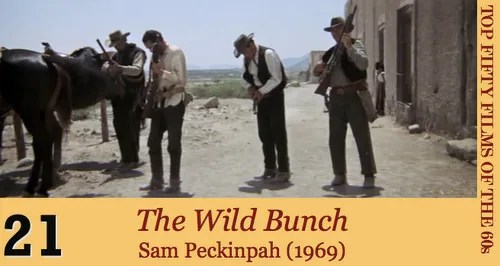
#21 — The Wild Bunch (Sam Peckinpah, 1969)
I’m going to wind up dealing with this sort of thing again when I get to the nineteen-fifties, so let’s address it head on. When I put The Wild Bunch on this list, I’m referring to the version that Warner Bros. released in the mid-nineties, which was two minutes longer than the very first U.S. release, twelve minutes longer than the U.S. version that was the standard for around twenty-five years and identical to the only cut ever to make its way around Europe. Or so I’ve read. I presume that “Original Director’s Cut” version is now the standard, but I could be wrong. It’s definitely the first iteration of The Wild Bunch that made any sort of impression on me, watching it during the 1995 rerelease run, in a Madison movie theater that briefly devoted its biggest screen to revivals in the brief period before the DVD revolution made such a thing practically unfeasible in a mid-sized market like that. And it was a helluva impression. As I’m sure director Sam Peckinpah would prefer, I was floored.
John Wayne famously groused that The Wild Bunch destroyed the myth of the American Old West, at least as far as the movies were concerned. It’s perhaps shortsightedness on the Duke’s part that he didn’t notice the wall already scrawled with that particular writing, although he might be forgiven considering that the same year as Wild Bunch he had a sizable hit that led to an Oscar win with True Grit. Peckinpah’s film doesn’t deliver the western’s eulogy, but it does stare down the genre with weary, weathered eyes. Set in the second decade of the twentieth century, the film follows a band of outlaws nearing the end of their days, led by William Holden’s Pike Bishop. They’re hoping for that fabled last score that can let them retire, which eventually leads them into far more treacherous territory south of the border, where they get wrapped up with a brutal Mexican general (Emilio Fernández) who is effectively terrorizing a small town with his control of it. Pike’s men are criminals, but they adhere to a moral code. As they consider their place in this world that’s coming unhinged from the unspoken pledges of honor that used to guide it–a wistful nostalgia that may itself be false–they sink into a bleak necessity to set things right with the only skills they’ve developed over the course of a long life, skills that exact a deadly toll.
Even by modern standards, the violence of the film is extreme and extraordinary (the film’s rerelease was held up as Warner Bros. fought the NC-17 the MPAA wanted to slap on it), punctuated with exploding squibs of blood. Peckinpah drew a direct corollary with the human agony of the then-current war in Vietnam, broadcast nightly into American homes. The director wanted to offer a nasty counterpoint to the movie gunfighter of an earlier era whose firearm was shot out of his hand, spilling not a speck of blood. He thought audiences would be horrified and was dismayed to find that they were instead charged up and excited by the onscreen carnage. Besides the sad truth that the Romans will always cheer for the lions if given the chance, there’s the fact that Peckinpah was too skilled for his own good. Whether they have the impact he intends or not (for me they do), the scenes of violence are mesmerizing and almost poetic, making suffering and death into a visually striking tableau.
Decades after its release, The Wild Bunch remains remarkably kinetic. It’s also lucid and clear, something that the more edit-happy modern directors could stand to study. Peckinpah wasn’t try to titillate or distract an audience. He was trying to live up to a responsibility he decided he had, a responsibility to own up to distortions of violent impact perpetrated by years of movies, especially westerns. He may not have been taking dead aim at the western myth Wayne wanted so much to preserve, but Peckinpah was wiping away the deceitful cleanliness of previous cinematic men who squint beneath their cowboy hats as they dispense justice. As with other filmmakers in the nineteen-sixties, Peckinpah was coming to terms with his medium’s opportunity and obligate to put truth ahead of all other things.
Discover more from Coffee for Two
Subscribe to get the latest posts sent to your email.
 Coffee for Two