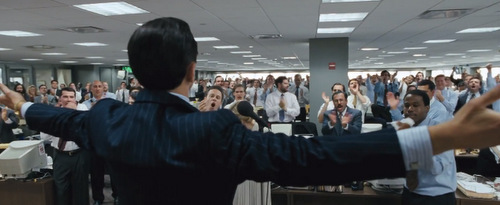
One of the benefits of getting to my reviews later than the full-on professional critical community is that I can see the ebb and flow of the cultural consensus before I weigh in. None of that shapes my reaction to the respective films (at least that’s my clear goal), but it can give me a foothold in how to frame a piece, especially since it sometimes takes me a few extra days to siphon a viewing experience into a glowing bundle of words. Since I saw Martin Scorsese’s The Wolf of Wall Street, it’s clearly become the most divisive movies of the year, with some reacting virulently against its swelling excess, presented with a notable lack of judgment by the director. Others celebrate it as his best in years, usually citing either 1990’s Goodfellas or 1995’s Casino as the worthy antecedent, proving that either they’ve been undervaluing the exceptional work he’s done over the course of the past decade-plus or–more tellingly, given the titles cited–that they really just want Scorsese to make the same film over and over again. The Wolf of Wall Street fits snugly into the same storytelling structure as his previous mobster rise-and-fall mini-epics, with the even more vicious world of speculative banking standing in for organized crime. It’s not one of Scorsese’s strongest films (to offer my own historical perspective, I think it’s his first significantly flawed fiction film since 1999’s Bringing Out the Dead), nor is it some wrong-headed abdication of moral responsibility. It’s a good movie, messy and slightly malformed. Scorsese is a brilliant filmmaker, but he’s allowed to the occasional middling feature.
The Wold of Wall Street tells the story of Jordan Belfort (Leonardo DiCaprio), an up-from-nothing kid whose interest in becoming a stockbroker takes a major hit when his first official day on the job coincides with the most devastating day in the market since the Great Depression. Without more legitimate–though, as it’s depicted in the film, still morally slippery–work, Jordan turns to dealing in penny stocks, an especially low grade part of the financial business that happens to pay outrageously high commissions. Using an innate skill for salesmanship, Jordan eventually develops a major firm, netting himself unfathomable riches in the process. The film is ostensibly about his eventual comeuppance, brought down by drugs and hubris, but the bulk of its three-hour running time lavishes in the trappings of Jordan’s wealth and the masculine splendor of his hedonistic style. Working from a screenplay by his Boardwalk Empire creative partner Terence Winter, Scorsese basically turns the sequences of Goodfellas that portrayed the seedy privilege the gangsters enjoyed into an entire film, although with much of the seediness removed. Henry Hill had to go through the kitchen to get his prime seat at the Copacabana, but Jordan seems to simply land in his mansion.
There are certainly compelling moments in Jordan’s rise, most notably his more hardscrabble beginnings. Watching him ply his trade in a converted garage with a ragged group of cohorts is far more interesting than the ludicrous pageantry and abusive excess of the major brokerage house he nurtures into being. Similarly, a scene in which Jordan has an one-on-one conversation with the FBI agent (Kyle Chandler) who’s investigating shady dealings has a spark to it that is too often missing from other portions of the film, in part because the friction gives the character of Jordan some much-needed shape. DiCaprio has had a splendid run with Scorsese, but, game as he is, the character is too amorphous for the actor to get a handle on. His journey from naif who’s unnerved by the cockeyed rantings of one of his first bosses (Matthew McConaughey) to self-appointed Master of the Universe (to borrow the famous Tom Wolfe phrasing from era) has no discernible path. At times, he even shifts too loosely between the two incarnations, apparently based on the desired dynamics of the scene rather than any reasonable character arc. He’s already a fairly feisty and in-command fellow with a bevy of extramarital sexual conquests to his credit when he’s somehow flummoxed by the hot blonde (Margot Robbie) who’s clearly coming on to him. He goes from commanding figure to borderline buffoon and back again like a guy trapped in a revolving door. Individual scenes may work dandy, but the whole doesn’t hold up.
This is still Scorsese, so the film has passages of audacious invention and is rife with fascinating elements demanding informed debate, including the closing shot, which seems to place at least a portion of the blame for Jordan’s greedy crimes on the endless audience of people prepared to believe a lie if there’s any chance it will make them rich with as little effort as possible. The Wolf of Wall Street is about modern myth-making and the ability of the wealthy class to escape any true repercussions for their worst actions. On some level, Jordan finishes the film with the same drastically diminished stature as Henry Hill and Ace Rothstein (and, for that matter, Jake LaMotta and Travis Bickle). As opposed to those previous Scorsese protagonists, Jordan’s life on the lower tier isn’t accompanied by an erosion of the soul. There’s a sense that his brand of hucksterism has allowed him to endure, as if he’s turned his expertly deceptive salesmanship on himself. The sprawl of the film may have gotten away from Scorsese for a change (his crack editor Thelma Schoonmaker was apparently instrumental in helping him get the film from four hours to three, and I’m certain there’s a truly great movie in here if she could have helped him shave off another twenty to thirty minutes), but he still deserves some amount of credit for how close he came to making this unwieldy, ambitious undertaking work.
It’s not a masterpiece. It’s not a disaster. It is clearly and unmistakably the work of an artist who remains committed to testing himself with every new film. And maybe that’s all it actually needs to be to be worthwhile.
Discover more from Coffee for Two
Subscribe to get the latest posts sent to your email.


The run-time may make and break some, but for me, I didn’t mind it. I loved it actually, as it gave me plenty more time to just digest everything in as it was happening at a lightning-quick speed. Good review Dan.