Like a lot of people, I suppose, my introduction to Oliver Sacks came through the movie Awakenings. Based on the nonfiction account of the same name, written by Sacks, the film depicted the efforts of a physician to treat catatonic patients in a Bronx hospital, bringing a heightened empathy and commitment to exploring possible solutions to a group of people who had been largely disregarded by other doctors, relegated to the category of the untreatable. The doctor finds success in a treatment, although it is tragically fleeting. In the film, Sacks is renamed Dr. Malcolm Sayer and played by Robin Williams, in one of the strongest performances in the actor’s career, one likely influenced by the respect he felt for the actual man (as opposed to some other real-life figures Williams played during his career, there seemed to be a true bond between actor and subject which developed into an abiding friendship, perhaps because both men carried a pronounced understanding of inner loneliness). It may not have really exposed me to Sacks’s words, but I do believe Penny Marshall’s fine film gave me a glimpse of his soul.
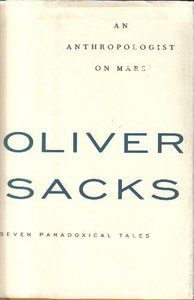
The first time I read Sacks came a few years later, when I procured a copy of his book An Anthropologist on Mars. At the time, this sort of writing wasn’t exactly in my wheelhouse. As someone who still meets most science-based writing with a mental reaction roughly akin to Homer Simpson’s undivided attention, trekking through case studies of neurological ailments was daunting. Across the seven extended essays in the book, I instead found Sacks’s writing to be anything but. Without dumbing down the material, Sacks makes the intricacies of misfiring brain chemistry remarkably accessible, writing about his patients (including a painter who loses the ability to see color, a physician with Tourette syndrome whose tics disappear when he’s performing surgery, and a man blind from youth whose mind revolts against his surgically restored sight) with the intense, perpetual fascination of an expert who knows with certainty that he will never fully grasp the mysteries of the field he’s chosen. Through his writing, an impossibly complex topic became approachable, the reader warmly invited to consider the landscape of the brain with the same wonder that Sacks himself clearly felt.
In recent years, Sacks increasingly turned his focus on his own experiences, detailing his experimentation with mind-altering drugs and, of late, reckoning with mortality, spurred by a diagnosis of terminal cancer, precisely the thing that finally claimed his life. There is an enviable clarity to these particular writings. He didn’t meet his own challenges with bravery exactly, but instead a clinician’s commitment to honest appraisal. There was no need to be maudlin, nor angry. He lived a life worth living, worth cherishing, worth celebrating. Fittingly, it is Sacks’s own words that hold the most weight for me when I think about who we was and my distant encounters with him, gratifyingly taking in his printed thoughts:
“There will be no one like us when we are gone, but then there is no one like anyone else, ever. When people die, they cannot be replaced. They leave holes that cannot be filled, for it is the fate — the genetic and neural fate — of every human being to be a unique individual, to find his own path, to live his own life, to die his own death.”
Previously…
—An Introduction
—Margaret Atwood
—Anne Tyler
—Michael Chabon
—Ian McEwan
—Don DeLillo
—Stephen King
—John Steinbeck
—Donna Tartt
—Jonathan Lethem
—Bradley Denton
—Zadie Smith
—Nick Hornby
—Kurt Vonnegut
—Thomas Hardy
—Harlan Ellison
—Dave Eggers
—William Greider
—Alan Moore
—Terrence McNally
—Elmore Leonard
—Jonathan Franzen
—Nicole Krauss
—Mike Royko
—Simon Callow
—Steve Martin
—John Updike
—Roger Angell
—Bill Watterson
—William Shakespeare
—Sarah Vowell
—Douglas Adams
—Doris Kearns Goodwin
—Clive Barker
—Jon Krakauer
—John Darnielle
—Richard Price
—Art Spiegelman
—Anthony Bourdain
—John Irving
Discover more from Coffee for Two
Subscribe to get the latest posts sent to your email.
 Coffee for Two
5 thoughts on “My Writers: Oliver Sacks”