I really should be dropping an old review of a Stephen King adaptation into this space, but I believe I’ve exhausted my supply of writing on the often-dire translations of the prolific author’s work. Instead, I’ll take as my prompt the season debut of the latest sprawling exercise in lavish provocation from Ryan Murphy’s television empire. I have no informed opinion to offer on Murphy’s recent television creations, except to say that I’m grateful to the FX Network for keeping him busy enough that he doesn’t have time to make more movies.
You can probably pull out any two or three scenes with Annette Bening from the new film Running With Scissors and make a case for some splendid acting going on, but the performance doesn’t really cohere within the film. That’s certainly due in part to the character Bening is playing: the mentally ill mother of future writer Augusten Burroughs. She is a writer, enchanted with her own creativity and consumed by her own misery. She’s also under the sway of a psychiatrist of questionable merits who keeps her well-stocked with mind-altering pharamaceuticals, so, to a degree, it makes sense that there’s not much of a through-line to the character. But just because something is understandable (or within the scope of audience rationalization) doesn’t make it satisfying. What’s worse, the problems hindering Bening’s performance are apparent elsewhere. Inconsistency and offputting exhibitionism may be suited to her chracter, but those are also apt, unfortunately descriptions for the rest of the film.
Ryan Murphy, creator of the FX series Nip/Tuck, wrote the screenplay (adapted from the bestselling memoir by Burroughs) and directed the film, demonstrating little facility for either task. It’s easy to pick out individual directorial transgressions — Bening pops her first pill in import-heavy slow-motion so preposterous and cliched that it must be awkward and ill-chosen parody; a time transition achieved through a fast-motion static shot of a movie theater exterior — and dismiss them as the missteps of first-time feature director anxious to create something artistic and challenging and different. What’s really dreadful is the mangled tone that the script and the direction conspire to create.
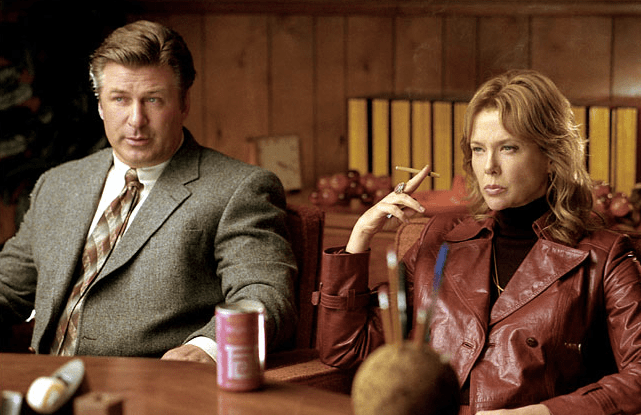
For the bulk of the film, Augusten Burroughs (played adequately if unimpressively by Joseph Cross) is in his early teens, and the life he’s living is a series of horrible challenges. Besides the fragility of his mother’s psyche, his departed father wants nothing to do with him and he’s dispatched to live with the warped therapist in a giant, filthy house stacked high with the discarded detritus of life, from empty food cans to ancient Christmas trees. He bonds with one of the man’s daughters and falls into a sexual relationship with another adopted son, a disturbed man in his thirties. This is a troubled and troubling journey, but Murphy clearly strives to balance the discomfort with a sort of bleak humor (consistent with the approach Burroughs took in the original book, I believe). Those sort of tone shifts require great deftness, and Murphy just doesn’t have it. The resulting wreck relies on sitcom-style set-up and punchline gags, cheap scatalogical jokes and pushy art direction to squeeze laughs from the 1970’s costumes and decor (look there’s a can of Tab! And avocado-colored appliances! What a riot!) The humor is too self-satisfied to be funny and it leeches any power out of the dramatic moments. These are sick, lost people, and its sometimes hard to sympathize when them after the movie had so aggressive prodded us to laugh at them first.
Early on, the voiceover narration announces this is based on a true story, adding that without that assurance no one would believe it. There’s some cause for this as the film never does feel authentic. It’s not because of the extreme circumstances, though; it’s because of the incredible bungling of the filmmakers.
Discover more from Coffee for Two
Subscribe to get the latest posts sent to your email.

