
347. Guadalcanal Diary, 2×4 (1987)
Guadalcanal Diary evidently sought to recapture something they felt they lost when they recorded their third album, 2 x 4. After an excursion with other collaborators, the band from Marietta, Georgia returned to the producer of their first album, Don Dixon. Famed among the left-of-the-dial set for his behind-the-boards efforts on R.E.M.’s earliest triumphs, Dixon tied Guadalcanal Diary to a scene they often sought to distance themselves from. They weren’t a band from Athens, Georgia, but were often lumped into that grouping, simultaneously benefiting and suffering from the inevitable comparisons. Like almost everyone else with a noncommercial bent, they could skew in the direction of the college-rock standard bearers — “Little Birds,” on 2 x 4, could be a Fables of the Reconstruction outtake — but Guadalcanal Diary had their own distinct brand of charging, joyful pop rock.
The album opener, “Litany (Life Goes On),” is an exuberant triumph, merging an explosive melody and powerhouse sound with sharp, direct lyrics celebrating the vast possibility of living open to experiences (“We move so quickly/ Who knows where the time goes/ Where does this road lead?/ No one knows, no one knows”). It’s a shaky, hopeful manifesto as assertive pop statement, and it’s absolutely perfect.
The rest of 2 x 4 is solid, if merely adequate in comparison to its opening salvo. “Get Over It” sounds like a stab at winning over the poppier programmers in the album rock radio sphere, almost like the Bangles before they cracked the code of crossover success. “Let the Big Wheel Roll” is suitably bouncy, and “Winds of Change” is churning college rock. The post–bar time ballad “3 AM” is a tick too precious, and “Lips of Steel” tinkers with psychedelia, a sound that sits slightly awkwardly in the band’s more dapper sound. It’s an ill-fitting, tie-dyed jacket
Guadalcanal Diary was making good music, but they were also starting to wear out. Not long after the release of 2 x 4, guitarist Jeff Walls and bassist Rhett Crowe married, entering into a settled domesticity that made the necessary touring life, a grueling undertaking under any circumstances, less appealing. Guadalcanal Diary released on more album, 1989’s dandy Flip Flop, before disbanding, more or less for good.

346. Echo & the Bunnymen, Echo & the Bunnymen (EP) (1984)
“It was a record company idea, really,” Ian McCulloch, the lead singer of Echo & the Bunnymen told a reporter who asked about the self-titled EP the band released a few months before their fourth studio album, Ocean Rain. “I suppose it makes sense, because we get misinterpreted so much, misrepresented.”
The crossed-up calculations McCulloch referred to were about the band’s general outlook. Maybe because their general style — led by McCulloch’s bushy mop-top — drew knee-jerk comparisons to more gothy brethren, such as the Cure, there was a perception that Echo & the Bunnymen regularly mired themselves in material that had a gloomy outlook. Their emotional register ran more of a gamut than that. Selections for the EP deliberately skews towards more upbeat fare.
The EP is also dominated by material that had already been released. “Rescue” is nicked from the 1980 album Crocodiles, and both “The Cutter” and “The Back of Love” previously appeared on the 1983 studio effort Porcupine. The main newcomer on Echo & the Bunnymen is “Never Stop,” a tense single from the previous summer presented here in a slightly extended version referred to as the “Discotheque” mix. The EP’s closer is of greater interest, in part because it makes the most persuasive case that Echo & the Bunnymen could deliver a very different vibe than swooning moroseness. The disc ends with a live version of “Do It Clean” that brings a bracing garage rock sound to the song and includes McCulloch riffing through a medley of other songs, including the Beatles’ “All You Need Is Love” and James Brown’s “Get Up (I Feel Like Being a) Sex Machine.” The toughed-up playfulness makes a better case that the band is fun than anything that came before it.
In his contemporaneous accounting of the EP, McCulloch indicated that it was just a survey of the different dimensions of Echo & the Bunnymen. It was also a preview and a promise of what was to come when Ocean Rain saw its official release in a few weeks. The band was determined to convince listeners that they had a sunshiny side.
“More uplifting,” McCulloch responded when asked to describe the forthcoming album. “There’s quite a bit of happiness in it.”
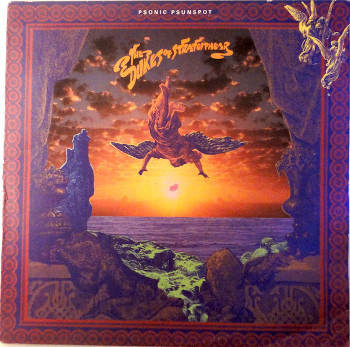
345. The Dukes of Stratosphear, Psonic Psunspot (1987)
Most didn’t expect Sir John Johns, the Red Curtain, and Lord Cornelius Plum, known collectively as The Dukes of Stratosphear, to make more than one album. Sir John Johns was perhaps more skeptical than most. And yet there the trio was, working with producer John Leckie, who’d had great success presiding over the earlier efforts of XTC, on a new assemblage of trippy, tantalizing tunes that feel transported straight from the hallucinogenic haze of the late nineteen-sixties. If their first studio effort, 25 O’Clock, was deeply beholden to the Beatles after Bob Dylan introduced them to strong drugs and they let their hair grow long, the sophomore outing was more of a homage to the other droopy-eyed denizens of the same creative era, such as the Beach Boys and the Hollies, or so Sir John Johns, in his alter ago of Andy Partridge, told The New York Times at the time.
The Dukes of Stratosphear was a splendid side trip for XTC, the dream band they retreated to when they found their day gig dissatisfying. they were in a particular funk after the recording of Skylarking, released in 1986, having skirmished mightily with producer Todd Rundgren. Guitarist David Gregoruy, a.k.a. Lord Cornelius Plum, later suggested that XTC might not have outlasted the nineteen-eighties if they hadn’t had the creative respite of the Dukes of Stratosphear.
Psonic Psunspot, the fanciful band’s sophomore effort, is kaleidoscopic pop bliss. “Vanishing Girl” so expertly captures the bygone era that it’s a wonder it wasn’t plucked from a Nuggets-style compilation of head-trip gems. “Have You Seen Jackie?” is a deliberately confusing swirl of gender signifiers, and “You’re My Drug” is a chipper, densely imaginative love song (“You take me to heaven from deeper than hell ever dug/ And you fly me higher than a trip on a magical rug”). “You’re a Good Man Albert Brown (Curse You Red Barrel)” is plucked from an alternate universe where Small Faces’ Ogdens’ Nut Gone Flake was a rock opera inspired by a misremembering of Charles M. Schulz’s Peanuts. “Brainiac’s Daughter” is a giddy goof, the best post-Beatles lark that none of the fabs ever got around to recording.
After Psonic Psunspot was released, there was idle — likely insincere — speculation on the part of Partridge that the Dukes of Stratosphear’s pastiches could explore other flavors of nineteen-sixties British rock. ” They should sound like The Merseybeats of The Easybeats, before they started getting a bit bendy,” Partridge said. “The Equals, Dave Clark Five. I’d love to write a song for The Troggs.” Sadly, none of that was meant to be. XTC persevered for only a few more years, and there was never another album credited to the Dukes of Stratosphear.
The original version of this post erroneously featured the 1987 self-titled LP from Echo & the Bunnymen at #346. That album actually appears at #20 on the chart, and the official entry for that album can be found here. To read the original entry for #346, go here.
To learn more about this gigantic endeavor, head over to the introduction. Other entries can be found at the CMJ Top 1000 tag. Most of the images in these posts come straight from the invaluable Discogs.
Discover more from Coffee for Two
Subscribe to get the latest posts sent to your email.
 Coffee for Two