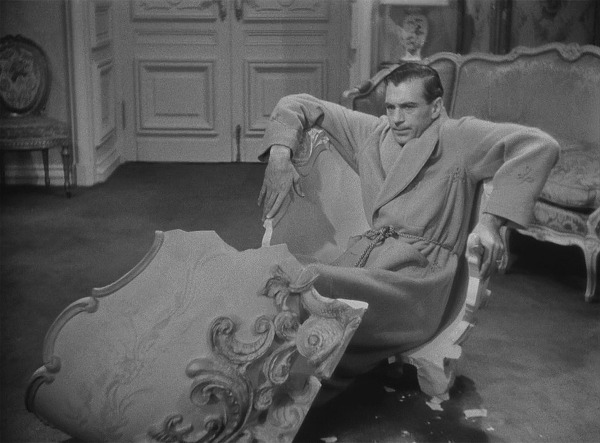
Bluebeard’s Eighth Wife (Ernst Lubitsch, 1938). This comedy boasts the first screenplay collaboration between Billy Wilder and Charles Brackett, and it’s just as sly and salty as any informed film fan might hope. In a scene that could put in a claim on being the invention of the meet-cute, gruff businessman Michael Brandon (Gary Cooper) demands to buy only the top half of a set of pajamas in a French Riviera department store. An amused fellow patron, Nicole de Loiselle (Claudette Colbert), steps in to procure the bottoms, and the pair are off on a courtship that hits its first snag when Michael reveals he’s been married seven times before. Bluebeard’s Eighth Wife is tartly funny in its consideration of matrimonial romance, particularly among the wealthier classes that see spouses as merely another commodity to be traded. Wilder and Brackett layer in crafty gags, and director Ernst Lubitsch brings his trademark precision to deploying them for maximum effect. The tone and pace tilt towards full screwball without quite ever getting there, which proves nicely satisfying. Cooper and Colbert both give strong performances in roles that decidedly play to their strengths, and David Niven is amusing as one of Nicole’s catty cohorts.
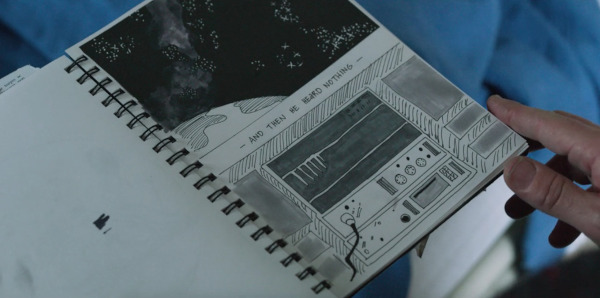
The Land of Steady Habits (Nicole Holofcener, 2018). To date, this is the only film directed by Nicole Holofcener that is built on an adapted rather than an original screenplay. Maybe that’s part of the reason The Land of Steady Habits doesn’t quite work. Holofcener never seems totally connected to the material, and neither does her cast. Ben Mendelsohn plays Anders Harris, who’s hopelessly adrift after a divorce. He is snidely combative with his ex-wife (Edie Falco) and flailing in his attempts to bond with his troubled adult son (Thomas Mann). Anders connects with Charlie (Charlie Tahan), the creative but distraught son of some friends, a friendship that takes problematic turns related to Charlie’s self-medicating drug abuse. The film is often as lost as Anders. The plot moves with no urgency or much of a discernible point. It is a series of incidents that vaguely add up to character growth. Holofcener is too shrewdly observant of a screenwriter for the film to be a complete failure. Individual scenes work well, but nothing adds up. It’s easily the weakest of Holofcener’s features.
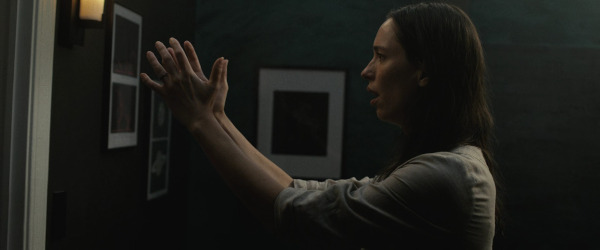
The Night House (David Bruckner, 2020). The Night House is a finely calibrated mood piece about grief that grows less interesting as it steadily shifts into more conventional supernatural horror. It’s not as if the film can’t bear the intrusion of the fantastical, especially because the strongest sequences leave it somewhat ambiguous as to whether the poltergeist menaces is really present or is a creation of the lead character’s unraveling mind. Instead, the issue is that director David Bruckner casts aside the restraint he’s previously brought to the film in favor of noisy chaos. The film features a sensational performance by Rebecca Hall. She plays Beth Parchin, a teacher mourning her husband, who took his own life. Alone in the elaborate lake house that he built for them, Beth goes through Owen’s belongings and discovers evidence that he was fascinated with arcane writing and symbolism, some of which he might have integrated into the architecture of their home. Hall is fiercely committed to every moment. She carries her character through a torrent of emotions and is especially uncompromising in the potency of her anger. Hall is so strong that other aspects of the film, including supporting performances by highly capable actors, wilt in comparison.
Discover more from Coffee for Two
Subscribe to get the latest posts sent to your email.
 Coffee for Two
Even though you didn’t care much for it, I’m sorta interested in viewing The Land of Steady Habits because of its setting. That phrase is one of several mottos for my home state of Connecticut, and sure enough, the novel/movie is supposed to be based in Westport. I’m always interested in depictions of Connecticut, because I want to see how accurate they are to the place I spent my first quarter-century of my life. The problem is often that most are set in the Gold Coast, the tony Long Island Sound touching area of Fairfield County (excluding Bridgeport) that everyone thinks is all of Connecticut, a world away from where I grew up. And most films that depict Connecticut are shot in Southern California, which doesn’t have the same look as Southern New England. The only semi-recent one that I felt got it “right” was Revolutionary Road, where it definitely looked like the place I grew up. (Some scenes were even shot not far from where I lived.)