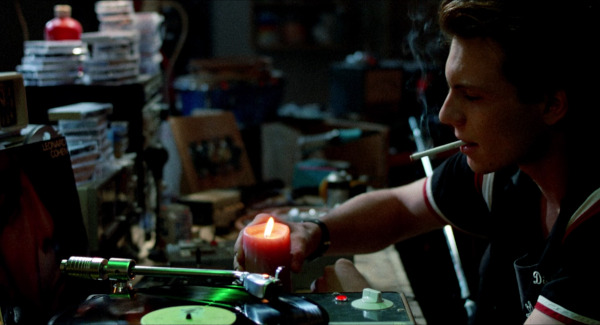
Pump Up the Volume (Allan Moyle, 1990). A disaffected high schooler (Christian Slater) copes with his family’s relocation to some lousy suburbs in the customary manner. He starts a pirate radio station where he plays Leonard Cohen records and yammers out raunchy rants about the misery of modern life. Naturally, his on-air alter ego becomes a cult hero among the fellow students who otherwise won’t give him a second look, and the stuffy authorities do everything they can to shut down the illicit broadcasts. Pump Up the Volume boasts some solid acting from Slater. As the cool girl who becomes infatuated with the underground gabber, Samantha Mathis is even stronger, which is especially impressive because she’s stuck with a character that shifts according to narrative whims of Moyle’s screenplay rather than any coherent internal logic. Apart from the two leads, the film is filled stiff performances that only heighten the flatness of the dialogue. This is rebellion delivered in a woefully glib package. When Slater’s character identifies his own demographic cohort that was not yet commonly called Generation X as instead “The Why Bother Generation,” it stands as maybe the only moment in this movie that has really aged well.
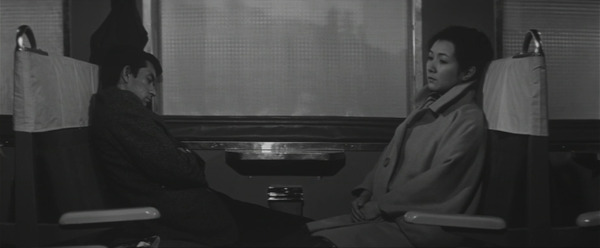
Yearning (Mikio Naruse, 1964). In a small, tight-knit village, Reiko (Hideko Takamine) is a widow who runs a small grocery store. Conflict arises when the store’s continued viability is threatened by a newly opened grocery store and everyone in the family has differing opinions about how to respond. Along the way, Reiko also learns that her brother-in-law Kōji (Yūzō Kayama), who is several years younger, has harbored a longstanding love for her that he’s dealt with by drinking and behaving recklessly. Yearning is part stern drama about capitalism eroding community and part melodrama of doomed love. Either way, it’s effectively wrenching. Working from a script by Zenzō Matsuyama, director Mikio Naruse carefully emphasizes the emotions of the piece, whether they simmer or flare. Naruse also makes the film a visual wonder. He contructs widescreen images with a meticulous clarity that recalls the masterful work of his countryman Yasujirō Ozu.

Still Life (Jia Zhangke, 2006). Jia Zhangke’s shot composition is marvelous across Still Life, and the film’s drama is piercingly effective in its quiet consideration of human connection in a era of destruction and reconstruction. The film goes back and forth between a couple different stories that have the unifying theme of married couples who exist in a disconnected state from each other. Jia’s storytelling is slow but also weighted with clear purpose. He takes his time because its worth it to deeply consider the landscapes, the feelings, the people. The truth becomes clearer the longer its looked at. I don’t think the few reality-bending inserts work, most notably a couple shots of spaceships incongruously cutting across the gray, urban scenery. To be clear, though, Jia is so firmly in command otherwise that I could definitely be convinced that my reservation is a failing of my own evaluative powers and imagination rather than a true shortcoming of the film.
Discover more from Coffee for Two
Subscribe to get the latest posts sent to your email.
 Coffee for Two
I remember liking Pump Up The Volume when I saw it on VHS almost a decade after its release (I’m surprised I didn’t see it on VHS after its release), so I’ll take your word on the apparent deficiencies in its structure. But thinking about it, it’s A Very 1990 Movie because it straddles two decades/eras: The “stiff performances, flat dialogue, glib package” and the tidy conclusion of a 1980’s teen movie, and the attention to alternative music/culture and subversive tendencies of the 1990’s.
It’s interesting to see Slater in two movies that had completely opposite takes on teen suicide and so close together: The black humor of Heathers and the earnest dealing with this one. It’s also interesting to note how long Slater played a teen in movies, as at this point he would have been 20/21.
And Samantha Mathis! It’s definitely a bit of male fantasy fulfilment to be a socially inept outsider and have the hot goth girl take a likin’ to you. (Guilty.) She does a fine job, though checking her Wikipedia she didn’t have the greatest track record of parts. I mean, how can you explain being the lead in Atlas Shrugged, Part II?
And despite its unrealistic representation, the movie helped catalyze an interest in pirate radio. Too bad its promise never paid out. I wonder what pirate radio (and the radio landscape in general) might have looked like if broadband internet was delayed a decade.
Samantha Mathis showed so much promise in this performance, but she never quite clicked in various big and small roles. Still, continuing the work in her chosen business is a feat in and of itself, so good for her.
The pirate radio/broadband internet situation you bring up is an interesting one. It seems that internet could have been the place for an equivalent of pirate radio to crop up, if not for the smothering effects of the music industry and the Digital Millennium Copyright Act. There could have been a legion of Hard Harrys out there. Who knows – maybe there are.
Yeah, there were quite a few actors, especially in the 90’s, whom I thought showed real promise but somehow couldn’t deliver. And it is still respectable that someone like Mathis still finds work (and was a SAG officer for a bit!) There’s also other forces that weren’t obvious that prevented an actor from reaching a higher level, like with Ashley Judd. She was another actress that I really liked and got bummed that she never got her big break, and now we know it’s because she rebuffed Weinstein. I’m sure there’s many more promising actress from the 90’s-00’s whose careers stalled because of this.
Well, I don’t know if I want a legion of Hard Harrys, per se, but it would have been nice to see a bit more democracy on the radio waves. And the media trope of the Hard Harry DJ–someone who speaks truth to power via the airwaves–pretty much died out once the internet got big.