I’ve read a lot of horror novels over the years, but the scariest book I’ve ever consumed was Command and Control, Eric Schlosser‘s weighty tome about the feeble protections associated with the nuclear weapons arsenals across the globe. Repeatedly in this nonfiction warning flare, Schlosser’s exhaustively details a number of instances when it seems that nothing more than dumb luck helped humanity evade annihilation when stray errors made it perilously likely that missiles were about to start crisscrossing the skies. I thought of that book often as I watched A House of Dynamite, Kathryn Bigelow’s new film, and felt my shoulders growing tighter and tighter.
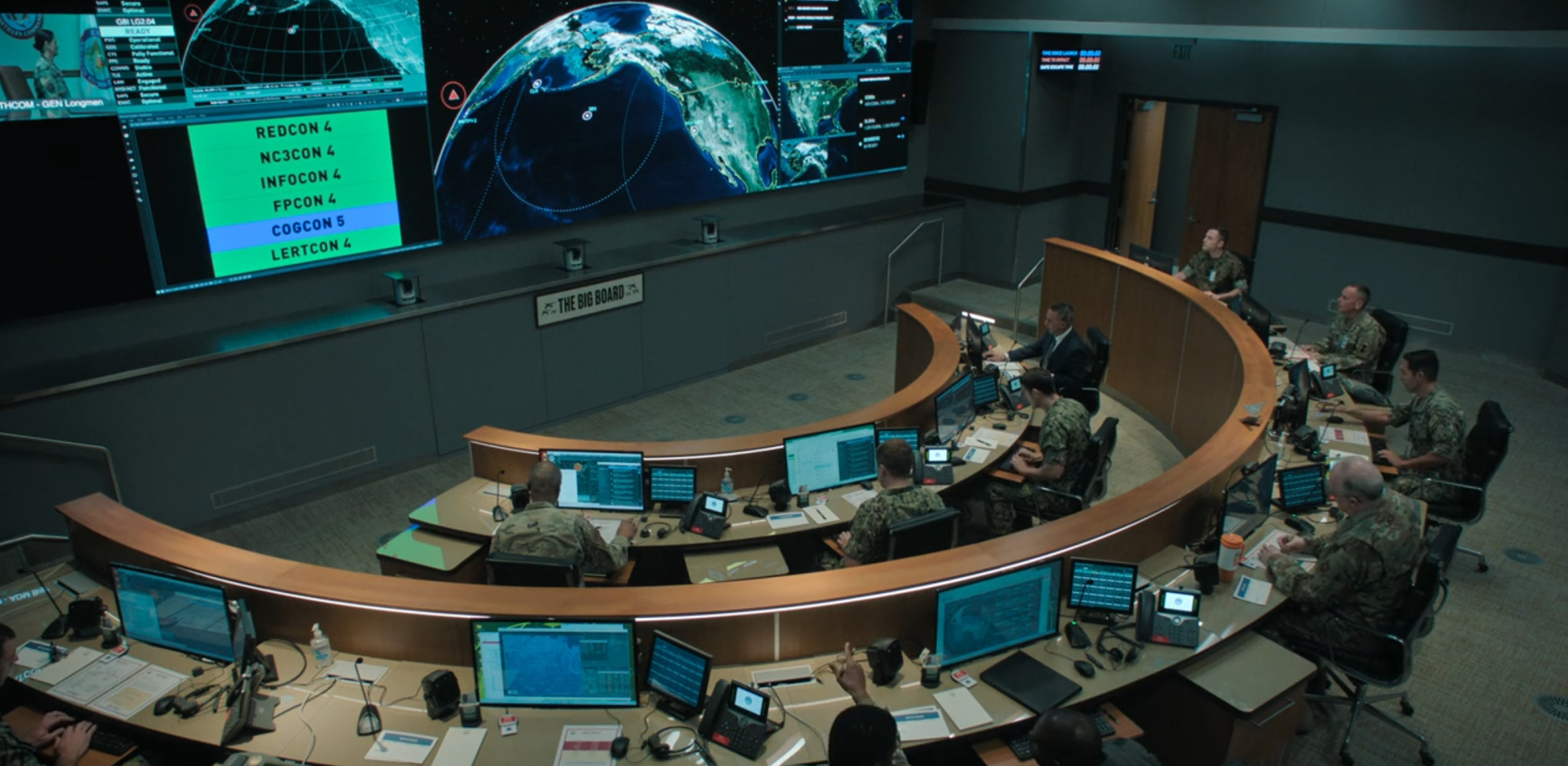
A House of Dynamite takes place on what starts as a mundane workday for a range of U.S. government officials. Initially, the film connects itself tightly to Olivia Walker (Rebecca Ferguson), a senior official in the White House Situation Room. She heads into her secure workplace, locking her personal cell phone in a case outside the door, and joins her colleagues in monitoring the geopolitical landscape. Then a blip appears on the screen. The concern level is low. They’ve seen this before. It’s probably just a missile test. Soon, though, it becomes clear that the blip represents an ICBM that is racing towards a target in the continental United States.
The storytelling approach taken by Bigelow and screenwriter Noah Oppenheim, a former head of NBC News, is to burrow into the procedural steps taken by government officials doing their jobs. These are sometimes high-ranking federal employees, all the way up to the U.S. president (Idris Elba). No matter their place on the national org chart, they are fallible human beings responding to a situation that they trained for but never really believed would occur. The whole narrative is an exercise in depicting individuals realizing they are out of their depth, that maybe they’re in waters so treacherous that no one could safely swim there.
The filmmakers are so fascinated by process that after the harrowing situation plays out, they circle back and start it all over again, now focusing on other characters who were maybe little more than jabbering heads in boxes on a video meeting screen in the previous segment. If the secretary of defense (Jared Harris) or the STRATCOM commander (Tracy Letts) initially come across as surprisingly peripheral to the story, the narrative that reboots itself from a different angle corrects that. By the end, most of the major figures has been given their moments to fret and sweat. Maybe the main message of the movie is that none of them is a white knight with a solution.
The approach of the film doesn’t heighten tension so much as repeat it, perhaps to slightly diminishing returns. Even so, if a film is going to home in on the mechanics of an institution, it can’t have a better currently working director than Bigelow at the helm. In her hands, A House of Dynamite is an astonishment soaked in well-earned pessimism. The geopolitical world has constructed a danger that’s impossible to escape. Bigelow know it, and she puts it compellingly on the screen.
Discover more from Coffee for Two
Subscribe to get the latest posts sent to your email.
 Coffee for Two