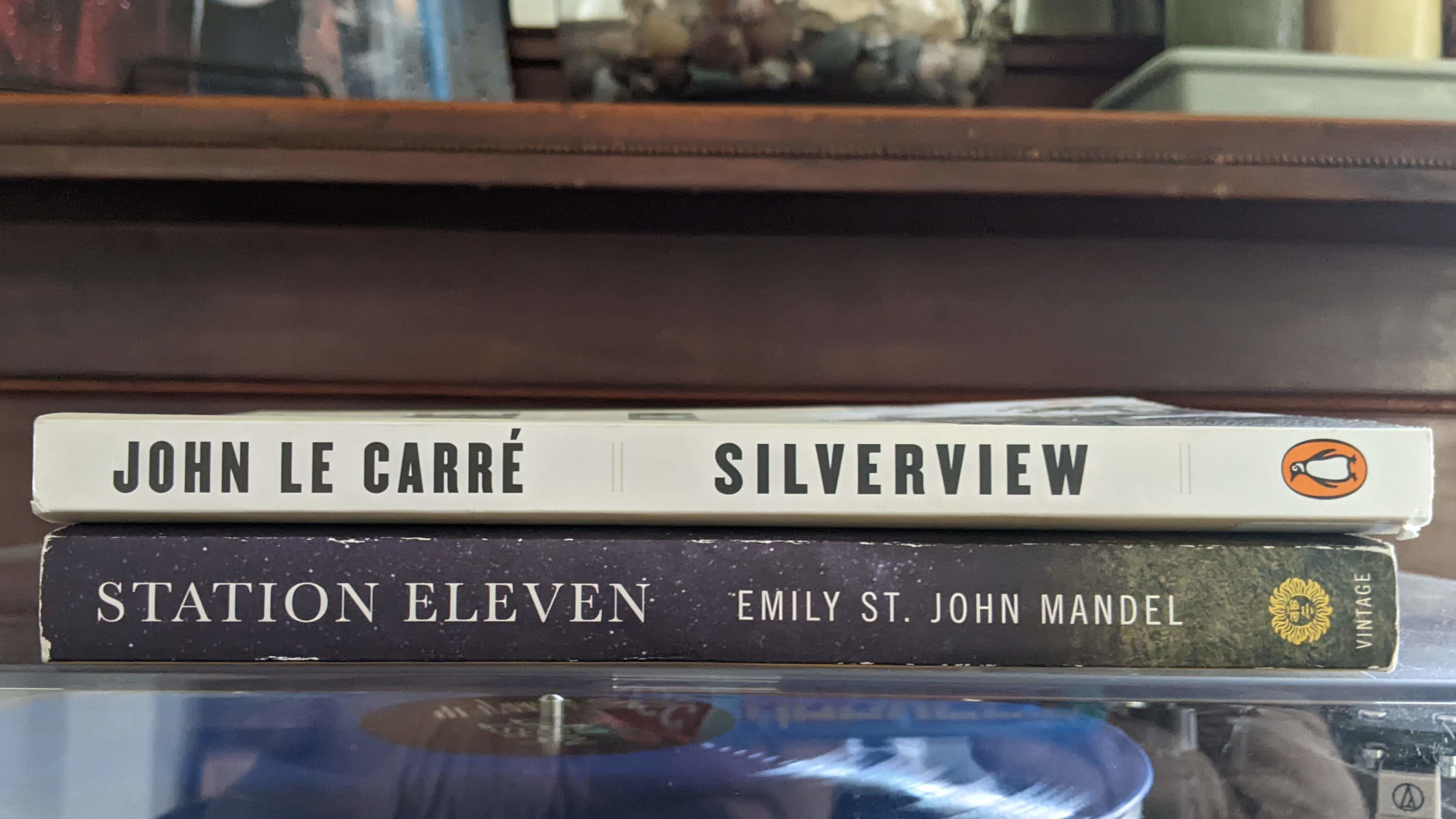
Silverview by John le Carré
Fiction, 2021
She was small and resilient, with dark hair cut like a boy’s and a mouth pulled tight on the slant. She wore floppy jeans and a chef’s striped apron with red hearts for pockets. Her first look at him was long and frank: his blue blazer, knitted silk tie, jute carrier bag with the Lawndsley Better Books logo stencilled on it. She had her father’s deep brown eyes. Pulling the door half shut behind her, she took a step downward to his side. Then, in a quaint gesture of relief, she shoved her hands into the pockets of her apron and rolled her should at him in peer companionship.
John le Carré’s final novel, Silverview, was published posthumously after his son Nick Cornwell handled the commonplace duties of putting a final polish on it. I don’t know that it feels like a fully committed elegy, but there’s definitely a pall of cynicism across the story. In le Carré’s rendering, systems are breaking down, allegiances are fragile, and practically every relationship is imbued with duplicity.
Although I’m hardly a completists, I’ve read enough to le Carré’s work to recognize his elegance, both in the prose and the overall thought that goes into the novel. If Silverview doesn’t exactly have the heft of a modern classic, there’s an assurance and clarity that marks it as a sure-handed expression of a master of the form.
Station Eleven by Emily St. John Mandel
Fiction, 2014

The lobby was oddly empty. There was no front-desk staff. The concierge wore a surgical mask. Miranda started to approach him, to ask what was going on, but the look he gave her was one of unmistakable fear. She understood, as clear as if he’d shouted it, that he wanted very badly for her not to come near him. She backed away and walked quickly to the elevators, shaken, his gaze on her back. There was no one in the upstairs corridor. Back in her room, she opened her laptop and, for the first time all day, turned her attention to the news.
I came at this well-regarded novel after watching — and adoring —the limited series screen adaptation that was released right after its story of a society in collapse was made intensely pertinent by the COVID-19 pandemic. Making the comparison in reverse was especially strange given that there are fascinating liberties taken by the television version, and that some of those changes yielded my strongest emotional responses as a viewer. I didn’t miss them, though. It’s merely a curiosity. Emily St. John Mandel’s storytelling is so fiercely true and quietly insightful that Station Eleven feels made to hold infinite permutations.
The book manages to almost clinical in its sociological astuteness, effectively imagining and conveying cultural breakdown with a clarity that reminded me of Cormac McCarthy’s The Road, albeit with the bleakness scaled back. The breadth of that vision is complemented by a warm intimacy with the many major characters across the book. They are all given interior lives that resonate. The whole book feels like a deeply personal expression from each of them. It’s exceptional.
Discover more from Coffee for Two
Subscribe to get the latest posts sent to your email.
 Coffee for Two
Station Eleven has been on my list for a while. After reading your review, I’ve decided to pick up a copy when I can. Sounds right up my alley.
Thanks, Dan
I’m glad I helped you finally start reading it. I think you’re going to enjoy it. Let me know what you think!