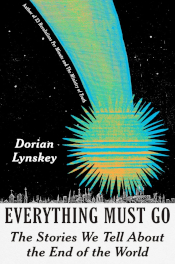
Everything Must Go by Dorian Lynskey
Nonfiction, 2024
At one fantastical extreme, the machines are horrifyingly perfect. Technology unites with religious prophecy in Arthur C. Clarke’s 1953 story ‘The Nine Billion Name of God’ when a group of Tibetan monks hires a supercomputer to calculate all of the deity’s names. A week before the process is due to finish, the two supervising engineers find out what they are a part of. Once the names are tabulated, says one, ‘God’s purpose will be achieved. The human race will have finished what it was created to do, and there won’t be any point in carrying on…bingo!’ The story’s final line is crisply chilling: ‘Overhead, without any fuss, the stars were going out.’
I truly adore the premise behind Everything Must Go. Going back to almost the dawn of recorded storytelling, Dorian Lynskey considers all the different ways that creators have envisioned the end of the world. Without explicitly laying out his thesis (well, not too explicitly anyway), Lynskey makes a convincing argument that trends in what kinds of threats emerge in these works of fiction are informative reflections of real-life anxieties. He blocks out sections by different methods of doom — robots, pandemics, climate change, and so on — giving the whole endeavor additional sociological heft.
I mainly enjoy the book for Lynskey’s entertaining recaps of the tales he finds in the various short stories, novels, radio programs, movies, and television series he assembles in his research. He’s not that intensive of a critic, preferring to let the tone of his summaries slyly convey his opinion. A touch of academic plainness occasionally intrudes, but the work is largely a brisk, light read about what is fundamentally a subject with the darkness of the gallows.

Crying in H Mart by Michelle Zauner
Nonfiction, 2021
“Gwaenchanh-a, gwawnchanh-a,” she said. It’s okay, it’s okay. Korean words so familiar, the gentle coo I’d heard my whole life that assured me whatever ache was at hand would pass. Even as I was dying, my mother offered me solace, her instinct to nurture overwhelming any personal fear she might have felt but kept expertly hidden. She was the only person in the world who could tell me that things would all work out somehow. The eye of the storm, a calm witness to the wreckage spinning out into its end.
Michelle Zauner’s acclaimed memoir is a moving, meaningful work. The beloved musician behind Japanese Breakfast covers her own musical career only glancingly in these pages. Zauner instead digs deeply into the emotional journey she took while watching her mother struggle against and ultimate succumb to cancer. There’s a sharp attention to detail on display as Zauner favors an almost journalistic examining of her own feelings rather than some poetic romanticizing of the sorrow.
Importantly, Zauner keeps Crying in H Mart intently specific, which is the proper pathway to writing that is universal in its consideration of the human experience. The Asian market chain mentioned in the book’s title isn’t all that prominent of a setting, but it stands as a handy avatar for Zauner’s Korean heritage, which is probably the most consistent through line of the book. Her main journey is arguably coming to terms with a cultural background that once felt distant to her. Zauner’s embrace of her mother’s homeland and the country of her birth might be the book’s most poignant element.
Discover more from Coffee for Two
Subscribe to get the latest posts sent to your email.

