
Asymmetry by Lisa Halliday
Fiction, 2018
And what had my preconceptions been? That he would be both more and less the Sami I’d remembered. More boyish. Less boyish. Going a little gray behind the ears. He was going a little gray behind the ears, but this was less uncanny than the ways in which he seemed almost exactly the same. The squareness of his hairline. The singular shadows around his mouth. They unnerved me, these animated relics, but in an oddly pleasant sort of way—as it can be oddly pleasant to pass a stranger on the street and catch a whiff of your high school chemistry teacher’s shampoo for the first time in twelve years. We think we have evolved, we think the dross of consciousness is shed, and then all it takes to splice in a frame from 1992 is a noseful of Prell.
This debut novel has narrative daring in its pages. Lisa Halliday realizes the thesis of her title by presenting the story in multiple parts, the first two of which are notably divergent. In the first chunk of Asymmetry, Halliday tells the story of a romantic relationship between an acclaimed American author (who is clearly modeled on Philip Roth) and woman in her twenties who works in the trenches of publishes as she chips away at her own literary aspirations. The second portion of the book depicts the challenges faced by a man of Iraqi-Kurdish descent in middle of the early two-thousands, including dehumanizing treatment during an attempted trip through airports. The third segment of the novel, presented as a radio show transcript, slyly folds those two earlier parts together.
Halliday’s writing is lively and wry. There’s definitely an autobiographical slant to the earlier section; Halliday spent a few years entangled with Philip Roth in the early two-thousands. That portion of the novel doesn’t have the feel of voyeurism, though. Instead, there’s a flat factuality to how Halliday presents the details that makes the storytelling feel that much more authentic.
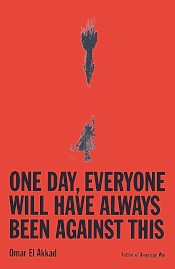
One Day, Everyone Will Have Always Been Against This by Omar El Akkad
Nonfiction, 2025
Waiting on a Western judicial institution to cast judgment on a killing spree financed and endorsed by the West means, inevitably, watching a disjointed ballet of impossible reconciling. The narrative—as enshrined in countless constitutions and declarations and charters which are so often held up as the differentiating marker of superiority of this world over the other—demands moral purity, opposition to injustice, adherence to the principle that all innocent lives are equal and deserving of dignity. The reality is that an ally of the West is killing civilians by the tens of thousands and it would be politically inconvenient to call this wrong now when for months, years, decades it has been deemed perfectly fine.
Omar El Akkad seemingly writes this book from a place of enraged exasperation. The title of the book is drawn from his own tweet about the astounding devastation of Gaza at the hands of relentless barrages from Israeli forces: “One day, when it’s safe, when there’s no personal downside to calling a thing what it is, when it’s too late to hold anyone accountable, everyone will have always been against this.” Across a couple hundred pages, El Akkad expands this sentiment into extensive diatribes against the cold-blooded war machine that grinds human brings in their gears and the so-called civilized nations that contribute to genocide, through appeasement if nothing else.
El Akkad’s writing has the moral clarity that recalls James Baldwin. His language has a similar erudition, though El Akkad renders his eloquent words with a harder steel, all the better to swing his arguments like weapons. One Day, Everyone Will Have Always Been Against This is essentially an op-ed piece stretched to greater length, but it never feels padded out. El Akkad’s wholly justifiable anger needs every page he gives it.
Discover more from Coffee for Two
Subscribe to get the latest posts sent to your email.

