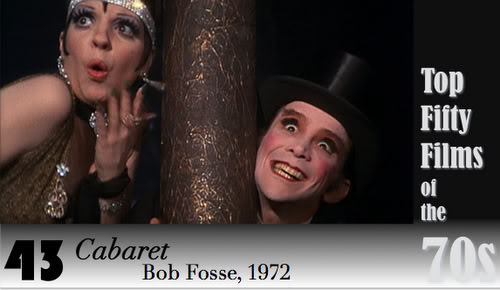
#43 — Cabaret (Bob Fosse, 1972)
Christopher Isherwood published a novel called Goodbye to Berlin in 1939. John Van Druten took that work and transformed it into a play called I Am a Camera, which was first produced in 1951, winning Julie Harris the first of her four Tony Awards for the central role of Sally Bowles. Fifteen years after that, the story was reinterpreted anew, this time with songs by John Kander and Fred Ebb and a book by Joe Masteroff. It was brought to the stage by director Harold Prince and choreographer Ron Field as a musical called Cabaret. It was a smash. When the time came to adapt it into a movie, Bob Fosse fought hard to make it the follow up to his somewhat troubled big screen directorial debut, Sweet Charity. He won the job, accepting the major stars who were already attached, and the long journey from the film’s seedlings decades earlier culminated in one of the most perfect convergences of talent of any film in the whole of the seventies.
Liza Minnelli plays Sally, an expatriate American cabaret singer in early nineteen-thirties Germany, when the upstart Nazi party was encroaching on control of the country. Much of the film’s plot revolves around her relationships with two different men, played by Michael York and Helmut Greim, but its driving energy comes from the musical numbers performed on the stage of the Kit Kat Club. The story is already darkened by the knowledge of the fascist regime to come, but the songs themselves are invested with their own astonishing menace. Every number, no matter how tender or upbeat, is a challenge, a snarl of anger, a broken bottle brandished in a bar fight. As performed by Minnelli and Joel Grey, the latter reprising the role of The Emcee from the original Broadway production, the songs are marvels of ingenious aggression. Against the backdrop of looming war, the songs become the last throes of freeing decadence, Sally’s garters and clinging vest representing the enticing possibilities lost when the whole world was ripped asunder by war.
Fosse’s direction is muscular, energetic and vividly leering. He presses in on his performers, letting their fervent energy rattle the entire film. There are few other creators who understood the visceral potency of music and dance as keenly as Fosse, and that conviction comes through with an almost startling power. It may be set in the past, but everything about the film feels strikingly modern, even now, forty years later. The frankness of the story contrasts with the lurid fantasy of the stage performances, the rasped promise that every ounce of a person’s desire can somehow be fulfilled with a song sung just the right way, a forthright kick, a look over the shoulder. There was often a sense that Fosse laid himself dangerously bare in his art, and Cabaret is a prime example of that.
The film also represents the consensus pinnacle for both of the main actors. Liza Minnelli may have a few entertainment world sins to answer for, but by god does she take command in this film. Sally is brash and fiery and vulnerable and troublesomely impetuous. The character was never American until Minnelli played her, but it’s now difficult to imagine her as anything but, given how well-suited the distinct sense of confident impropriety is to the nationality. Grey is an entirely other matter as The Emcee, one of the greatest horror film creations of all time, who seems to have wandered into the grim musical by chance and has decided to just go with it, snarling and grimacing and threatening to entertain the audience to death. His welcome of patrons into the cabaret makes the place seem like the darkest corner of Germany, no small feat given the blackening clouds outside their door. By the end, “Come hear the music play,” is both invitation and threat. The bleak genius of Fosse’s film is the subtle ways he’s spent the whole running time demonstrating that the distance between the two was never as vast as it seemed.
Discover more from Coffee for Two
Subscribe to get the latest posts sent to your email.
 Coffee for Two
I may eventually watch the movie, but I had to say — this was a very entertaining review just to READ. Novelists put less style and energy into their books than you did on this review.
Dang. Thank you very much. You’re too, too kind.
If I ever watch a musical that I’m not forced to watch, then I’ll make it this one.
It wouldn’t be a bad choice for that. The musical performances are basically all stage performances so if the contrivance of people bursting into song in unlikely places is a sticking point, this bypasses that problem. Kander and Ebb are fantastic songwriters too.