
Bel Canto by Ann Patchett
Fiction, 2001

There were deep white bathtubs with an endless supply of hot water pouring out of the curved spigots. There were stacks of soft white towels and pillows and blankets trimmed in satin and so much space inside that you could wander off and no one would know where you had gone. Yes, the Generals wanted something better for the people, but weren’t they the people? Would it be the worst thing in the world if nothing happened at all, if they all stayed together in this generous house? Carmen prayed hard. She prayed while standing near the priest in hopes it would give her request extra credibility. What she prayed for was nothing. She prayed that God would look and them and see the beauty of their existence and leave them alone.
This is the sort of airtight work that can be, should be, and almost certainly is routinely held up to explain the wonders that can be spun out of the novel form. Ann Patchett’s fourth full-length work of fiction was her breakthrough, and it’s not difficult to suss out why more than twenty years later. The is the story of a gala party, taking place in an unnamed South American nation, that is disrupted by an armed rebel sect that takes the attendees hostage allows Patchett to craft a bushel of finely considered character studies. The terrorist action quickly turns into a stalemate with the nation’s law enforcement and military forces, a cold war fought by forces on the opposite sides of mansion walls. Confined together for a long period of time, the marauders and their captors gradually settle into a strange new society where the mundane and the fraught exist side by side.
In addition to the emotional acuity present in Patchett’s writing, her efforts are distinguished by the clear care in the basic craft. The language is clean and vivid, always beautifully calibrated to convey what is needed in any given moment without a hint of ostentation. And yet it flows beautifully, with swells of uncommon eloquence and dazzling command. Bel Canto is a marvel.
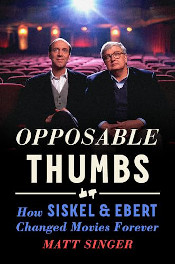
Opposable Thumbs: How Siskel & Ebert Changed Movies Forever by Matt Singer
Nonfiction, 2023
The nature of TV production required Gene and Roger to be the same height on camera, which they were not; Siskel was several inches taller than Ebert. “So Roger had a cushion to raise him up so that his head height would be similar to Gene’s,” recalls Bartley. This created a second problem: now Roger had a cushion and Gene did not. In Siskel’s mind, this was not fair.
“Well, then Gene had to have a cushion, too,” Bartley laughs.
The solution the crew eventually reached: Gene received a tiny cushion, while Roger sat on a much larger one. When both sat on their respective cushions, they looked about the same height on camera. (When Siskel & Ebert traveled to Florida to record shows at the Disney-MGM Studios theme park, the two pilloes had to be shipped down to Orlando to ensure continued cushion parity.)
From the moment this book was announced, I absolutely knew that I would roar through it with almost alarming speed once I got my mitts on its pages. Matt Singer comes to the joint biography of the two most famous film critics in history as a true believer. He’s an professional entertainment writer specializing in movies who deems the discovery of Gene Siskel and Roger Ebert on their weekly television show as the radioactive spider that bit his palm to set him irrevocably on the path that led him here. He writes the book with a clear commitment to getting it right, to capturing the way this duo could be transformative, indeed absolutely revelatory, to a nascent cineaste because of the way they gave independent and international film an equal footing with Hollywood blockbusters. Not that Singer needs a corroborating witness, but I’m fully prepared to swear on a stack of Ebert’s Movie Yearbooks that his conclusions are rock solid.
Beginning with its absolutely perfect title, Opposable Thumbs is giddily splendid entertainment for anyone who felt that watching the Chicago newspapermen bond and bicker across a faux balcony aisle was appointment television. As someone who watched Siskel and Ebert all the way back in their PBS days, when the show was called Sneak Previews, I’m especially ill-equipped to gauge how this book might read to someone who merely has some curiosity over a couple individuals who are now part of entertainment history, but I will note that Singer’s writing is brisk and engaging on its own merits. He is fair in noting the less admirable battles of ego and laudably thorough in sharing his research on how the partnership was landed upon and then evolved and cultivated across multiple, if determinedly similar, series. Plainly put, this book was everything I wanted it to be.
Discover more from Coffee for Two
Subscribe to get the latest posts sent to your email.
 Coffee for Two