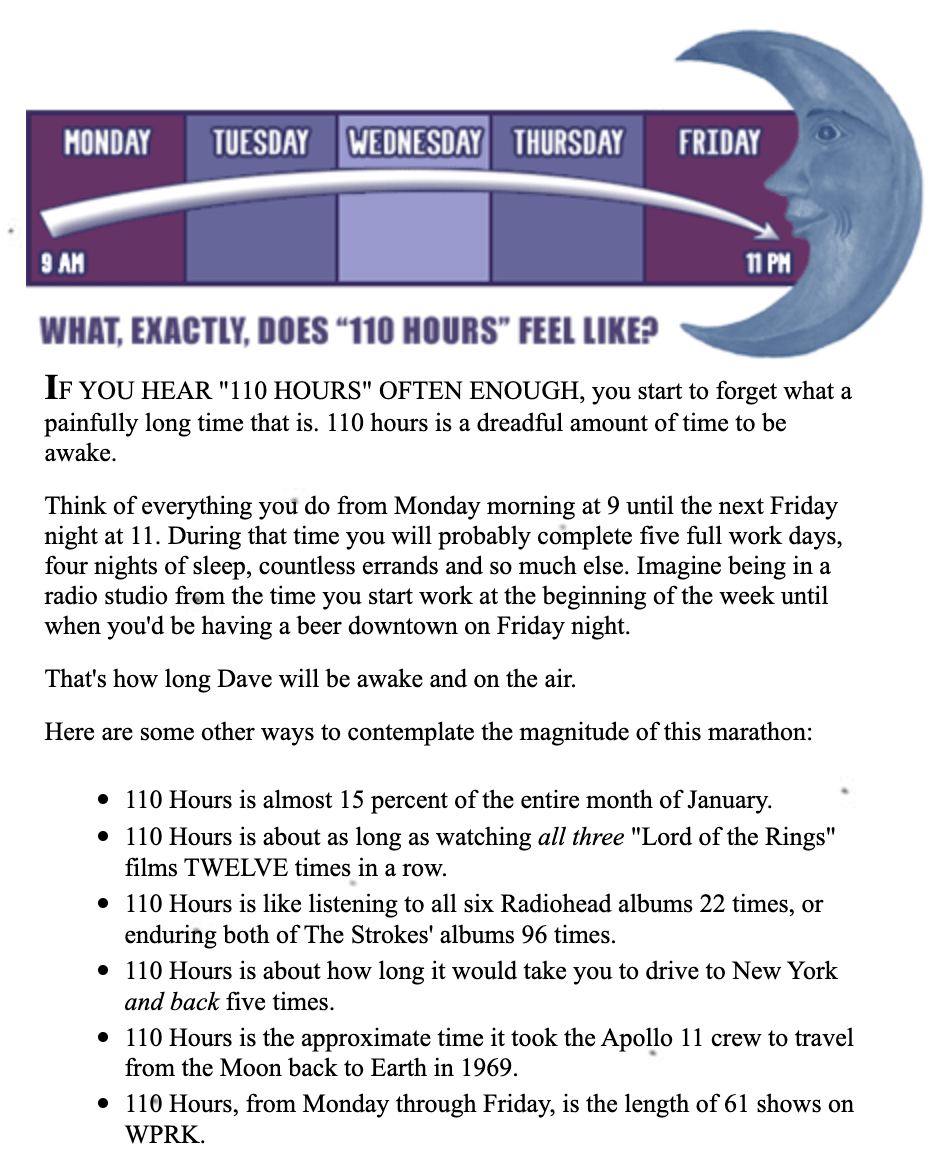
Dave Plotkin came to me with an idea. The idea was fascinating, exciting, and outlandish. Basically, it was the sort of idea that no one else could have come up with and yet felt natural as could be zephyring out of his perpetually engaged brain. Dave wanted to break the Guinness World Record for a solo continuous radio broadcast, and he wanted the effort to be a fundraiser for WPRK-FM, the student-run radio station where he volunteered and I served as the general manager and advisor. At the time, the record was 105 hours, so basically four and half days straight. Dave was determined to get to 110 hours.
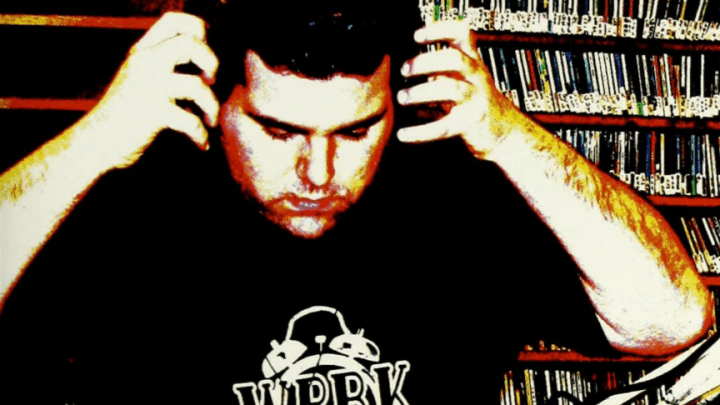
This proposal happened in 2004. As I was more or less obligated to do, I identified all the hurdles we needed to clear in order to make it happen. We talked about everything we required to ensure the college that held the station’s license would see the stunt as safe and would thusly provide the necessary support — or at least not try to shut it down midstream. We communicated with the Guinness folks about the strictures we needed to follow to satisfy them and worked through the logistics of recruiting the volunteer staff we would need to help meet those strictures. We discussed it with the student staff to gauge if they were prepared to do the heavy lifting required to make this mammoth undertaking a reality and to solicit their ideas about to how to make the programming as strong as it could be.
The planning was a back-and-forth process of determining how to best adhere to Guinness rules and also develop an environment that would keep Dave entertained and therefore awake. Guinness required that we have medical personnel on hand at all times and there be independent witnesses. Dave couldn’t play more than two songs in a row, and those songs couldn’t exceed six minutes in length. If he was talking to someone else on the air, the longest Dave could go without talking was one minute, so we determined we needed someone right next to him with a stopwatch who would give a nudge at around the fifty-five second mark.

A gregarious, inquisitive person by nature, Dave wanted the studio to be as busy as possible during the lengthy broadcast. We booked dozens of in-person and phone interviews to take place during the hundred-plus hours. We had local figures come in and provide demonstrations and other interactive activities for Dave. He took a trumpet lesson live on air and learned how to play a theremin. The station served the greater Orlando metropolitan area, so we called down to Nickelodeon Studios and got someone from to come and teach him how to make homemade Gak. We booked around sixty-five music acts to play live sets in the studio. Those performers had the follow the same rules as those set out for recorded music: no songs more than six minutes, and no more than two songs could be played without Dave speaking.
There were other accommodations that were even more bizarre. Dave, quite understandably, wanted to clean himself up everyone once in a while during his long time on the air, so he asked for access to a shower. We didn’t have those facilities handy anywhere near our basement studios, so Dave convinced a local retailer to set up a temporary shower that was fed from the sink faucet in the small bathroom down the hall. Dave showered live on air, talking the whole time. A student held a portable microphone above the shower to bring his running commentary to the listeners. He wanted a more comfortable seat than could be provided the hand-me-downs that furnished the station, so he worked out a promotional trade to get a nine-hundred-dollar Herman Miller Aeron chair for the week.
Dubbed the 110 Hours Marathon, the broadcast took place in January 2005. It began on Monday morning and lasted until late Friday, a full work week and them some, all without any breaks. I’ve long used the same shorthand description to explain what the on-air event was like to those who weren’t there: It was like backstage at The Muppet Show all the time. It was the pure definition of controlled chaos. It was also wildly entertaining. Dave was the perfect host for such an undertaking, alternating between goofy and endearingly serious. He was absolutely delighted with every odd turn of events, and that joy was infectious. Although we recruited a multitude of people to come be part of the program, the event also took on a life of its own, becoming a rambling circus that attracted additional participants with odd talents. More demos were added, as were impromptu interviews. A masseuse just showed up with her table in hand, providing luxury treatment to a line of weary staffers.
Dave was astoundingly resilient all the way through. His energy would occasionally flag only to have some bit of business tickle him and provide an adrenaline boost that would last for hours. Early on Friday morning, around ninety-five hours in, I thought Dave was surely done. He was exhaustion personified. I thought about telling Dave it was over, but we had managed to secure him a booking on Howard Stern’s morning show. Dave would be on Stern’s show, and Stern would be on Dave’s. There was no way I was going to take that away from Dave. The very moment the interview started, Dave’s entire being changed. Suddenly, he was as fresh and alert as he had been four days earlier when the Marathon began. Stern, still very much in his shock-jock era, clearly thought he was going to run roughshod over this dope in Florida. Instead, Dave was articulate and charismatic, completely short-circuiting Stern’s plans. The jolt from that interview carried Dave all the way through the rest of the day.
I genuinely don’t think I’m exaggerating when I assert that all of Orlando listened. The Orlando Sentinel offered adoring coverage of the Marathon every day. Neighbors and co-workers who had never showed the slightest of interest in the college radio station kept coming up to me to marvel at what was happening. “I can’t believe he’s still on the air,” they’d say to me, continuing to offer their color commentary. “I thought he sounded really tired for a while, but he seemed to perk up when the Feldman Dynamic bit happened!”
In the end, Dave did make it to 110 hours straight on the air. In the process, he raised around $17,000 for the radio station (which is the equivalent of around $27,000 today), far more than we’d ever pulled in one fundraising effort. His goal was to stabilize the station’s web-streaming capabilities, a costly, technologically daunting project back then. He signed off and exited the station, walking through a phalanx of people cheering for him. He went home and straight to bed, waking up the next morning after a normal night’s sleep. After all, there were more projects to get to, more brilliant schemes to hatch. As much as anyone I’ve ever known, Dave made the amazing happen.
Discover more from Coffee for Two
Subscribe to get the latest posts sent to your email.
 Coffee for Two
Well, that made me tear up, Dan! And have a renewed faith in the resilience and staying power of humans. Thank you. ❤
Thank you, Carrie. That means a lot.