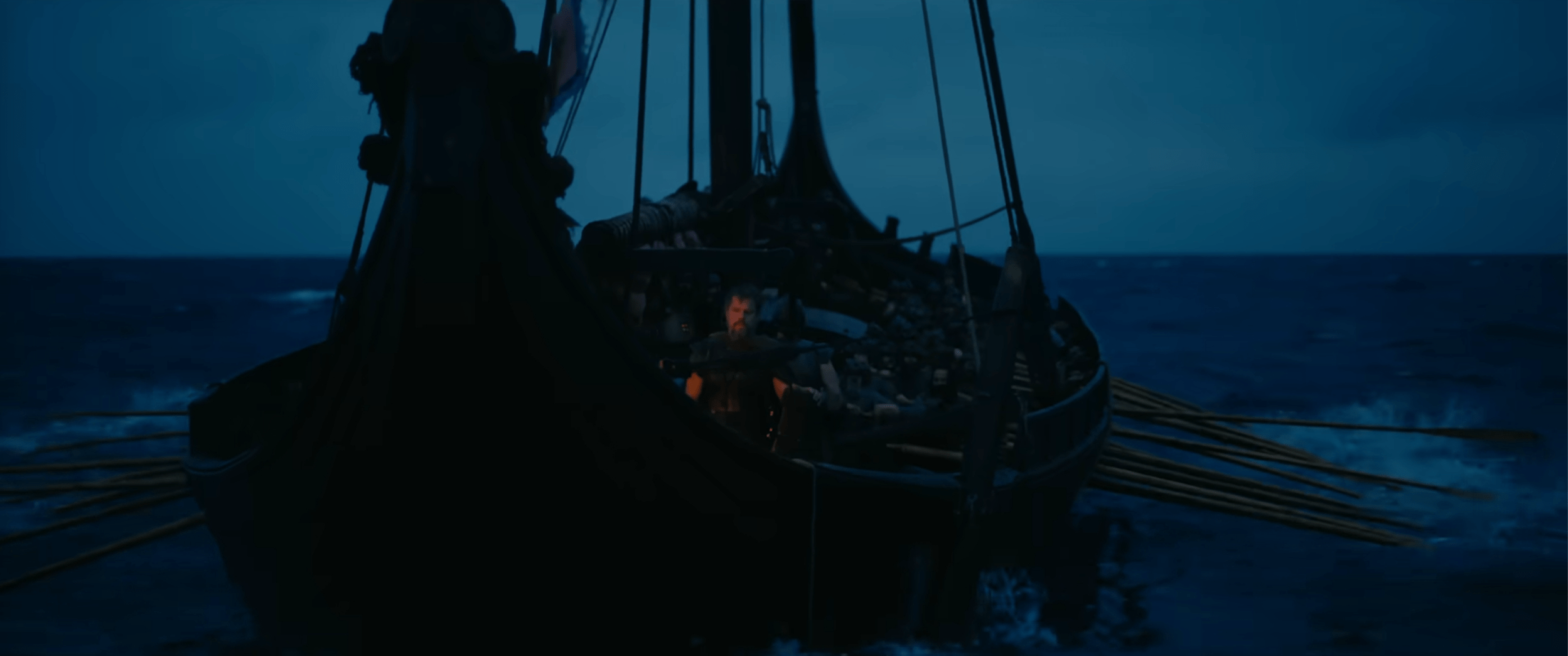
The Odyssey is the movie Christopher Nolan has wanted to make this whole time. That surely must be true. He has mounted cinematic efforts that folded space and time, aggressively flouted physics, marveled at the harrowing experience of warfare, reeled at the staggering wrath exacted by nuclear bombs, and turned a superhero story into a grand, garish opera of corroding human souls. Watching his intense, focused adaptation of a story so ancient that it basically helped to invent stories is to see a filmmaker bringing everything he’s done previously on the big screen to serve what he is doing now. Themes that Nolan has explored before — some of them with relentless repetition — are present here, rendered with a primal force. He has gathered the ideas that have long animated his art and tore them down to their bones.
Nolan also wrote the screenplay for the film, and he has brought his usual cunning twisting of chronology to the proceedings. He’s comfortable playing the hits; the tale of the Trojan horse — probably the one part of The Odyssey that absolutely everyone knows — is meted out carefully throughout the film’s nearly-three-hour running time. Around it, Nolan relays many of the other travails of Odysseus (Matt Damon), the king of Ithaca who leads an army through war and literally to Hell and back again. The film also regularly checks in on Penelope (Anne Hathaway), Odysseus’s queen who patiently awaits his return, much to the chagrin of the boorish suitors packed into her castle, all hoping to claim her in marriage. Meanwhile, Odysseus’s son, Telemachus (Tom Holland), mounts his own side quest to learn the history that has not yet been relayed back to Ithaca. Nolan keeps the story threads coherent, compelling, and, most importantly, entertaining. For his audience, no advance scholarship is required.
The scope is sweeping and the production is handsome. Whatever flaws have crept into Nolan’s films over the years, his command of craft has long been unquestionable. He makes space for his trusted collaborators — editor Jennifer Lame, cinematographer Hoyte van Hoytema, and composer Ludwig Göransson among them — to do exemplary work that mightily bolsters the whole. Using practical effects and real people and locations as much as possible, Nolan truly makes a long-past world come alive on the screen. An opening title card declares the film takes place “In a time of apparent magic,” and Nolan welcomes the sensational into his film. There is a giant cyclops (Bill Irwin), dead soldiers rising from the grave, and the goddess-witch Circe (Samantha Morton, in a marvelous performance), who remolds human beings with a body-horror gruesomeness that rivals David Cronenberg at his most joyfully depraved. No matter how feverishly unreal a moment might be, Nolan strives to bring it authenticity.
There is enough dynamic, dramatic action happening within the frame to make The Odyssey a singular achievement purely on the basis of its spectacle. It’s like a classic Hollywood epic transformed by a modern sensibility. It’s also much more than that. Nolan’s consideration of Odysseus’s journey deeply, honestly reckons with the psychological damage suffered in a vast society that rewards the ravaging of the other human beings. The film has the awesome, visceral power of Akira Kurosawa’s Ran and the savage emotional clarity of William Wyler’s The Best Years of Our Lives. It’s amazing and inspiring that Nolan gives equal weight to these two creative instincts that, on the surface anyway, are naturally divergent. He knows that they exist in tandem, that actions have repercussions that linger like undying echoes in a craggy valley. He makes sure his audience knows that, too.
Discover more from Coffee for Two
Subscribe to get the latest posts sent to your email.
 Coffee for Two