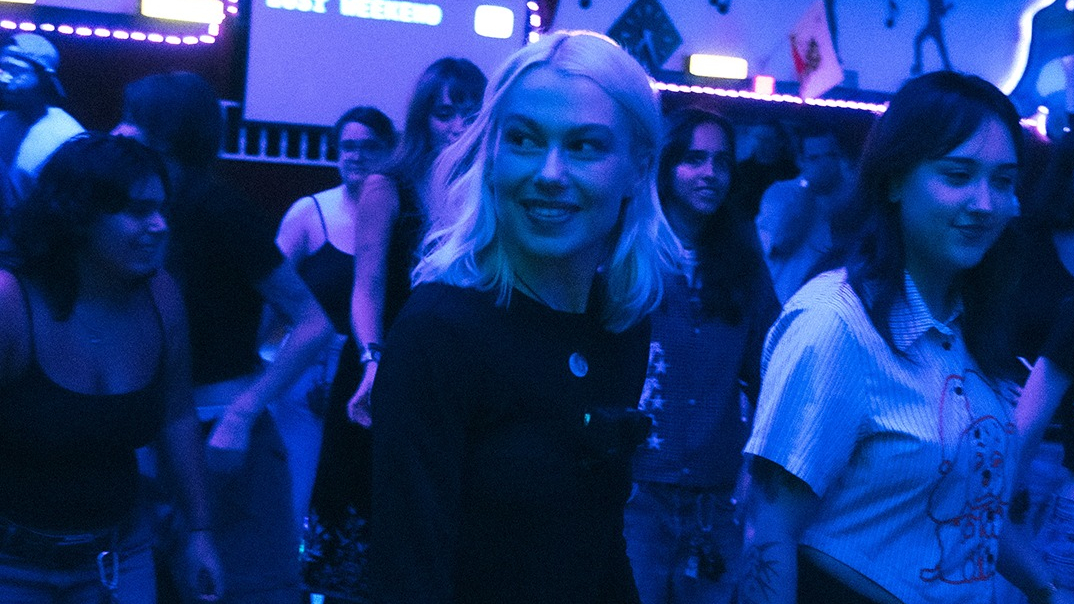
There was no way Phoebe Bridgers was going to get away with simply releasing a new album, not at this point. In the six years since her last solo album, Punisher, the axis of indie rock has tilted dramatically in her direction. The Record, the first full-length made with her pals Julien Baker and Lucy Dacus under the name Boygenius, was as close to a phenomenon as a release that tops out at gold sales can be, and Bridgers typhooned up to a whole other level of fame, with four shiny Grammys on her shelf as tangible testimony to her accomplishment. There was an intense curiosity about what she might do to keep progressing, to make a statement about her continued artistry, especially as she trailed Baker and Dacus in coming out with new material. Lost Weekend, Bridgers’s third album, is aptly described using the shopworn and often misapplied term “long-awaited.”‘
Bridgers is a collaborator at heart, and Lost Weekend is the fullest of houses. Tony Berg and Ethan Gruska shared producer credits on her first two albums, and they are back again, joined by Jack Antonoff and Alex G (and Bridgers herself, it should be noted). The liner notes are spotted with favorite coconspirators (Baker, Dacus, Conor Oberst, Christian Lee Hutson) and new, all-star buddies (Cameron Winter, Nickel Creek, current beau Bo Burnham). There’s no denying the primacy of Bridgers through it all, though. No matter how many people pitch in on a song, it always feels like Bridgers is exposing her purest, most unadulterated self through her music. In truth, her Boygenius bandmates are probably stronger overall songwriters than Bridgers, but she has a vibrant star power that is commanding and close to undeniable. She overtakes every moment.
Tomes of online speculation have already been offered about the probable backstory behind the lyrics. The death of Bridgers’s father looms larger, and Burnham is evoked multiple times using a pseudonym of Bobby. The devoted Bridgers scholars can trace which lyrics are about former romantic partner Paul Mescal and where a burn is being administered against Gracie Abrams. I’m not particularly concerned with all of that parsing. Lost Weekend is more interesting in its general emotional sweep, the ways in which it advances, expands upon, and casually subverts the trademark poignant misery and rueful humor of Bridgers’s career to date. She has a gift for relaying details that strangely get at a sense of being uncertain and marooned that seem especially pertinent a quarter century deep into this troubled millennium. Take the lively, spiky “Liberty Tree,” on which Bridgers sings, “I’m running through the airport/ Still putting on my shoes/ Not feelin’ any better/ I got too much money and nothing to lose.” It’s relatable and vast at once, achieved through fragmented, evocative language, like Rachel Cusk with a sense of melody.
At times, Bridgers seems reluctant to totally commit to her own openness. The album begins with with “The Outside,” which cloaks its raw emotions (“Screaming my ending/ Fist in the air/ You were there”) with heavily synthesized vocals. Elsewhere on the album, songs can be so hesitant that they’re barely there (“Other Plans”), as if bringing them to fruition would be too taxing. The overall tone of the album is somber, restrained, quiet. Because of that, I think it’s really defined by the many moments when a track veers into different sonic territory, as when the title cut abruptly switches from airy, forlorn folk into a flurry of new-wave blips and bursts. Bridgers continually discombobulates the listener, but always gently so: the punchy, swoony “Bobby,” the building jamboree of “Haunted,” the addition of twist-tie-tense Cameron Winter vocals on “I Can’t Wait.” Nothing is overly disruptive, many things set the album briefly askew.
What endures is Bridgers’s uncommon ability to make a song really land. She brings the components of her art together is a manner that feels effortless but is clearly meticulous. The lovely “The Governor’s Waltz” (“So let’s see how long we can go without touching/ Why don’t you sing me to sleep?/ I know you’d never actually think about jumping/ But do it for me”) is a fine example of her practiced ease. She’s by now keenly aware that her work will be scrutinized with fervor, and Lost Weekend is a dispatch rendered with care. The album opens with dark humor about the death of her father; the already much-quoted first lyrics are “Crying in a suit and tie/ But you should see the other guy. It closes with “Lost Weekend (Reprise),” and its last words are: “But we’re gonna be alright, me and you/ You love me and I won’t еver let you forget, not yеt.” Bridgers has gone on a proper journey. Her current elevated standing in the music ecosystem is a mark of her willingness to bring the listener along.
Discover more from Coffee for Two
Subscribe to get the latest posts sent to your email.

