
A Fish in the Bathtub (Joan Micklin Silver, 1998). Joan Micklin Silver’s last theatrical feature plays like a Woody Allen comedy for the elderly set — old-time jazz soundtrack, affection for New York communities, stories driven by shaky romantic relationships — but the writing is subpar. Real-life married couple Anne Meara and Jerry Stiller play Molly and Sam, respectively, a pair whose arguments come as naturally as breathing. Molly’s decades tolerating Sam’s unkind behavior reach a breaking point when he harangues her in front of a group of guests. Molly moves out, and the film tracks all the ripples that follow. It’s too bad Stiller spends so much of the film at full sitcom cantankerousness. His handful of more thoughtful moments are genuinely affecting. Meara is good throughout, always playing Molly with a clear empathy. Mark Ruffalo plays one of Molly and Sam’s grown children. He’s a little rough in this early role.

Terminator 2: Judgment Day (James Cameron, 1991). There’s so much to mull over with Terminator 2: Judgment Day, including all sorts of fascinating meta-textual elements. As inspired as it is to build this sequel around the switcheroo of the killing machine from the first film (or at least the same model of that contraption) being hurled backwards through time to serve as a protector for the previously hunted human, it remains amusing that the main impetus for the twist is that star Arnold Schwarzenegger’s Hollywood fortunes had changed so dramatically in the intervening years that it would have been problematic to cast him as the villain again. James Cameron’s direction is characteristically strong here. Action sequences are expertly assembled, the groundbreaking special effects are incorporated in a way that enhances the storytelling rather than distract from it, and the fundamentals of cinematic grammar — the use of offscreen space, the rhythms of exposition scenes — are first-rate. Working with William Wisher, Cameron shapes a screenplay that’s far better than most that he’s signed his name to. Linda Hamilton, Edward Furlong, and Robert Patrick are tasked with markedly different acting challenges, and each of them responds grandly.
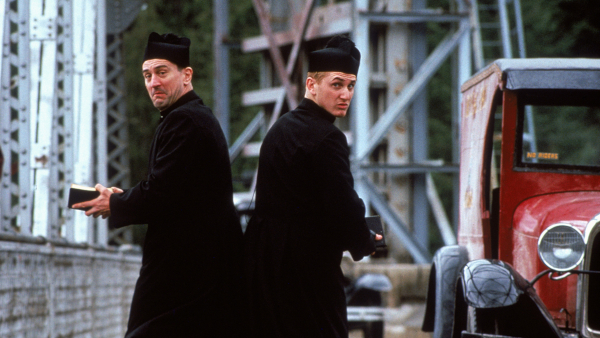
We’re No Angels (Neil Jordan, 1989). Except for its title and the vague concept of escaped prisoners interacting with the residents of an insular community, We’re No Angels bears little resemblance to the 1955 comedy it ostensibly remakes. Set in the nineteen-thirties, the film follows Ned (Robert De Niro) and Jim (Sean Penn) as they get caught up in a jailbreak. They make their way to a border town and plot to cross into Canada, but the priestly garments they don as a disguise mean they keep getting drawn into happenings in the local parish. David Mamet wrote the screenplay, and the humor has the clipped abrasiveness that might be expected from that credit. Neil Jordan directs smoothly but without the farce-like energy that would goose the material to life. It’s weird to watch a De Niro performance where he seems to be a doing an aggressive Robert De Niro impression. Penn is effective as the sweet, dim member of the fugitive duo, and Demi Moore has some snap when her beset single mom character calls for feistiness.
Discover more from Coffee for Two
Subscribe to get the latest posts sent to your email.

