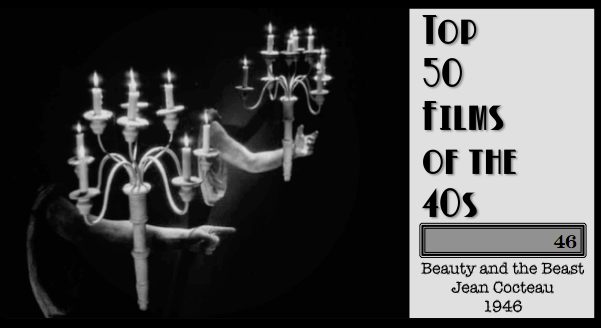
#46 — Beauty and the Beast (Jean Cocteau, 1946)
Jean Cocteau’s presentation of the classic French fairy tale La Belle et la Bête begins with a plea. In a written introduction, Cocteau invokes the intertwined sense of ready belief and excited wonderment with which children meet stories. He then calls upon all viewers, regardless of age, to engage his film with a similar openness to enchantment: “I ask of you a little of this childlike sympathy.” Cocteau then introduces the story in only manner suitable: “let me speak four truly magic words, childhood’s ‘Open Sesame’: Once upon a time….” This entry into the film is especially effective because the director has clearly adhered to his own guidelines, doing so earnestly and with affection. There’s not an inkling of stigma to telling what is ostensibly a children’s story. Indeed, it is so much more than that, not just because of the very adult themes threaded throughout it. The French version of the traditional tale, credited to novelist Marie Leprince de Beaumont, was first published in 1756 and stood as one of the revered pieces of homegrown culture in a nation that approaches its creative peaks with due affection. Cocteau was interpreted a work of art for his chosen medium. He needed to bring it to life properly.
Cocteau’s approach to the material is to find ways to unlock its mystical splendor that are uniquely cinematic. The story is of course familiar, with headstrong Belle (Josette Day) agreeing to serve as a companion to the leonine Beast (Jean Marais) is his isolated castle as a means of freeing her father (Marcel André) from imprisonment after he trespasses on the property. Belle eventually warms to the fearsome figure who is essentially her captor, and his eventual act of kindness, allowing Belle to visit her ailing father, leads in part to tragic circumstances befalling him, at least initially. This is the framework upon which Cocteau drapes elegant movie magic, in terms of both gentle stagecraft techniques adapted to the shadows of the sound stage and the sort of camera trickery that his countryman Georges Méliès first employed decades earlier. Beyond the facets of the film that qualify as special effects, Cocteau stirs up little miracles simply with the striking visual staging of scenes and moments. There’s no real bending of reality to, say, the way Belle’s cloak swirls as she strides through murky corridors, but the image holds it own sort of magic.
Gorgeous as Beauty and the Beast is, consistently and starkly, Cocteau is wise enough to prevent the film from becoming a staid art piece. There are intense emotions at the core of the story — love, of course, but also the fear and rage the Beast must face down — and the film remains trained on the heightened feelings. Fairy tales may have a surface simplicity, but that is often deceptive. By narrowing in on the basics of a story, fairy tales unearth truths so plain they’ve been taken for granted, lost amidst the adult desire to impose complexities onto everything to help explain all the resounding confusion. Sometimes — maybe even most of the time — it is the more direct version of a story is the one that should be told. Love happens, proved by sacrifice, and it is transformational. As Cocteau knew, it is worth believing in.
Discover more from Coffee for Two
Subscribe to get the latest posts sent to your email.

